
myChoice CDx PLUS

myChoice CDx PLUS is the first FDA-approved in vitro diagnostic test to determine Homologous Recombination Deficiency (HRD) status by NGS in patients with ovarian cancer.

Homologous recombination is the mechanism by which DNA damage is repaired. When homologous recombination is not able to fix the damaged DNA, it is called Homologous Recombination Deficiency. Approximately 50% of all ovarian cancer tumors have HRD. HRD status is determined by analyzing the tumor for mutations in the BRCA1 and BRCA2 genes and then by measuring genomic instability. Thirteen additional genes are also studied: ATM, BARD1, BRIP1, CDK12, CHECK1, CHECK2, FANCL, PALB2, PPP2RA2, RAD51B, RAD51C, RAD51D and RAD54L. If there is a mutation in these genes, or the measure of genomic instability is above a certain level, it is considered HRD positive (HRD+).
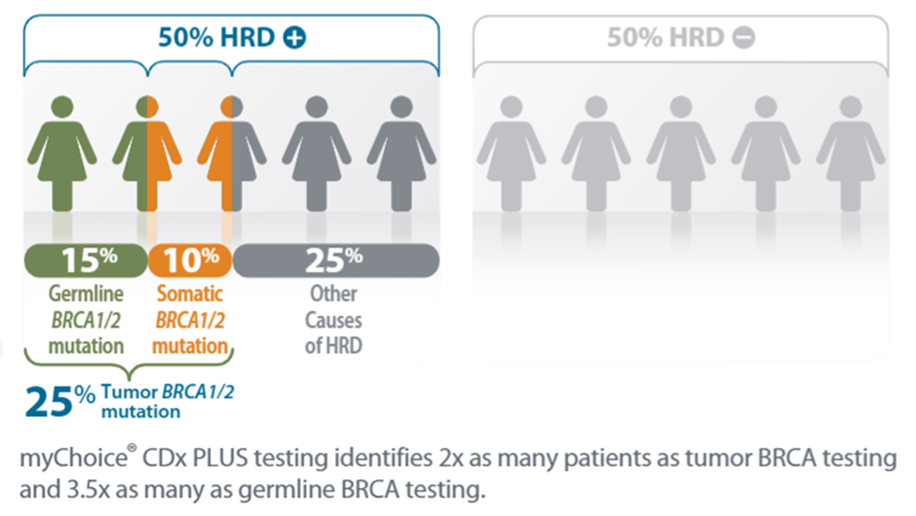
If the tumor is HRD+, it is more likely to respond to agents that block DNA repair, such as PARP (Poly ADP ribose polymerase) inhibitors (Olapariby Bevacizumab), than those tumors without genomic instability. When DNA damage cannot be corrected, cancer cells are killed, and tumor growth is slowed or even reversed. Thus, with myChoice CDx PLUS it is possible to evaluate the benefit of PARP inhibitor therapy in patients.

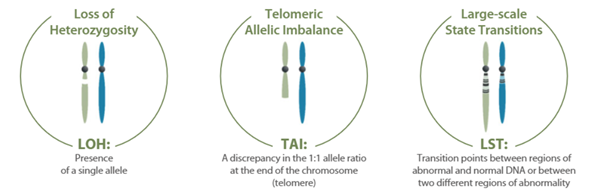
myChoice CDx PLUS enables the detection and classification of single nucleotide variants, insertions and deletions, and large rearrangements in the protein coding regions and intron/exon boundaries of BRCA1 and BRCA2 genes and the 13 additional genes mentioned, as well as the calculation of the Genomic Instability Score (GIS) using an algorithm that takes into account Loss Of Heterozygosity (LOH), Telomeric Allelic Imbalance (TAI) and Large-Scale Transitions (LST).
It is the only commercially available tumor test designed to detect large rearrangements, which account for 5% of all ovarian cancer mutations.

Key features:

  • Robustness
  • Accuracy
  • Reproducibility
  • Easy-to-interpret results

Área:

HRD, Sistema Reproductor, Sistema Reproductor, Tipos tumorales, Tumor sólido
Consulta a nuestros expertos

Google reCaptcha: Clave del sitio no válida.

Productos relacionados

VariantPlex ™ Solid Tumor Focus v2

Solución de diagnóstico in vitro diseñada para detectar variantes puntuales (SNVs), inserciones y deleciones(indels), alteraciones en el número de copias (CNVs), duplicaciones en internas tándem (ITDs) y biomarcadores complejos como el estado de inestabilidad de microsatélites (MSI) en 20 genes relevantes para cáncer de mama, melanoma, cáncer de pulmón (NSCLC) y otros tipos tumorales.
Archer Dx
Secuenciación masiva (NGS)

VariantPlex ™ Complete Solid Tumor

Solución de diagnóstico in vitro diseñada para detectar variantes puntuales (SNVs), inserciones y deleciones(indels), alteraciones en el número de copias (CNVs), duplicaciones en internas tándem (ITDs) y biomarcadores complejos como el estado de inestabilidad de microsatélites (MSI), Carga mutacional Tumoral (TMB) y Deficiencia de recombinación homóloga (HRD) en 430 genes relevantes para tumores sólidos.
Archer Dx
Secuenciación masiva (NGS)

VariantPlex ™ Expanded Solid Tumor

Solución de diagnóstico in vitro diseñada para detectar variantes puntuales (SNVs), inserciones y deleciones(indels), alteraciones en el número de copias (CNVs), duplicaciones en internas tándem (ITDs) y biomarcadores complejos como el estado de inestabilidad de microsatélites (MSI) en 76 genes relevantes para cáncer colorrectal, de mama, melanoma, cáncer de pulmón (NSCLC), páncreas y otros tipos…
Archer Dx
Secuenciación masiva (NGS)

VariantPlex ™ Pan Solid Tumor

Solución de diagnóstico in vitro diseñada para detectar variantes puntuales (SNVs), inserciones y deleciones(indels), alteraciones en el número de copias (CNVs), duplicaciones en internas tándem (ITDs) y biomarcadores complejos como el estado de inestabilidad de microsatélites (MSI) en 20 genes relevantes para cáncer de mama, melanoma, cáncer de pulmón (NSCLC) y otros tipos tumorales.
Archer Dx
Secuenciación masiva (NGS)