Franklin by QIAGEN is a cloud-based bioinformatics platform designed for the management, analysis, and interpretation of human genomic data. The solution centralizes case evaluation, quality control, variant prioritization, and classification into a structured workflow, facilitating the review and interpretation of complex sequencing data for specialized professionals.
Detailed Description
This cloud-based bioinformatics software has been developed for the analysis of germline variants from processed human genomic data. Its comprehensive approach allows working with FASTQ, BAM, and VCF files, applying validated bioinformatics pipelines for alignment, variant calling, annotation, interpretation, and custom report generation.
Franklin integrates genomic, phenotypic, and technical case information into a single environment, bringing together clinical metadata, HPO terms, panels, quality control metrics, and analysis results. This unified vision optimizes the workflow and promotes a more agile, structured, and consistent review.
Furthermore, its artificial intelligence-driven prioritization engine selects the variants most likely to be relevant for each case and presents them in the Workbench for review. This prioritization incorporates automatic classification according to ACMG/AMP guidelines, genotype-phenotype correlation, inheritance models, family segregation, and technical metrics associated with variant confidence.
To strengthen interpretation, Franklin consolidates evidence from more than 100 sources of genetic, genic, and phenotypic information, including public databases, internal laboratory data, and real-time community curation. Thus, it provides a robust environment for variant evaluation and the standardization of review criteria.
Clinical Applications
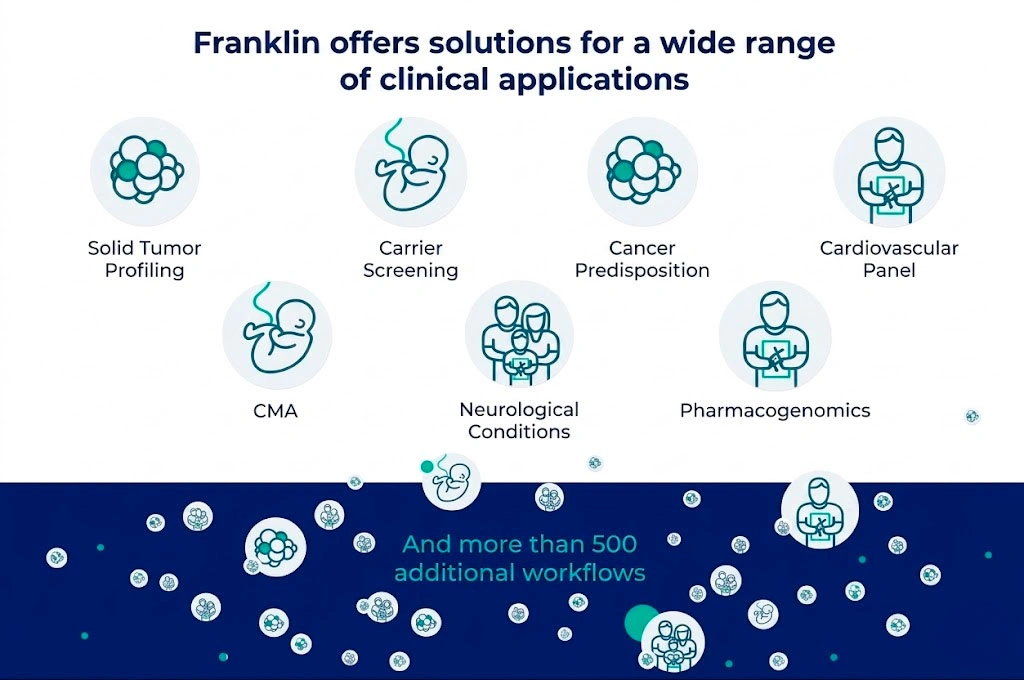
Data analysis from whole exome sequencing (WES), whole genome sequencing (WGS), chromosomal microarrays (CMA), and gene panels.Interpretation of variants associated with hereditary diseases.Evaluation of single nucleotide variants (SNPs and indels), copy number variants (CNVs), and more complex variants.Analysis of individual cases, trios, and extended families, including automatic checks such as consanguinity, family relationship verification, and uniparental disomy (UPD) in familial cases.
Benefits
Franklin stands out for its ability to centralize on a single platform all relevant case information, simplifying the review and improving process traceability.It allows starting the evaluation from a shortlist of AI-prioritized variants, accelerating interpretation and facilitating clinical decision-making.It incorporates specific tools for CNV interpretation, featuring detailed visualization, dosage sensitivity information, clinical evidence, and internal occurrence data.It promotes the standardization of the laboratory workflow, enabling internal variant classification, as well as community-level classification and frequency tracking.
Intended Audience / User
Software solution aimed at laboratories, hospitals, and organizations specializing in genetic analysis, interpretation, and reporting in a research environment.Especially suitable for laboratories seeking a centralized, scalable, and structured tool for germline variant interpretation.
Key Features
Comprehensive platform for the analysis and interpretation of germline variants, enabling a sample-to-custom-report workflow.
Full compatibility with FASTQ, BAM, and VCF data.
Variant prioritization using artificial intelligence algorithms.
Automatic classification strictly aligned with ACMG/AMP guidelines criteria.
Advanced interpretation of copy number variants (CNVs) and structural variants.
Integration of over 100 sources of genetic and phenotypic evidence in real-time.
Centralized management of case, phenotype, quality control, evaluation, and classification in a single environment.