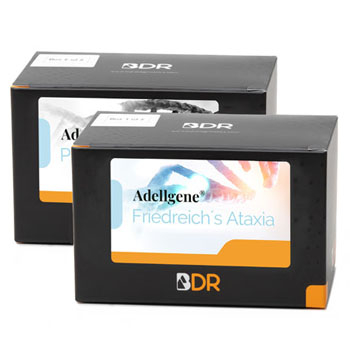
Adellgene® Friedreich’s Ataxia

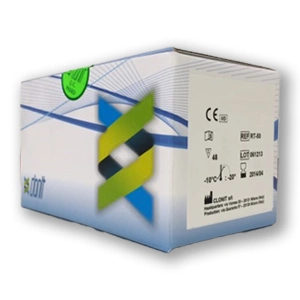
Kit for the determination of the GAA triplet repeats number of the FXN gene by fluorescent fragment analysis.

Information about the product

Friedreich’s ataxia (FRDA) is the most common hereditary ataxia and it´s an autosomal recessive degenerative disease.

The most common DNA abnormality associated with Friedreich’s ataxia (FRDA) is the expansion of a GAA triplet repeat polymorphism localized in the first intron of the gene encoding frataxin (FXN). Pathogenic GAA expansion alleles are in the size range of 50 to >1300 repeats with three different intervals:

  • healthy (between 5-30 repeats),
  • Mild symptoms (30-49 repeats)
  • Severe symptoms (50-1300 repeats)

Intended Use

Adellgene® Friedreich’s Ataxia is a semi-automated in vitro diagnostic kit designed for use in clinical laboratories which quantitatively determines the number of repetitions of GAA (guanine-adenine-adenine) in the first intron of the gene encoding frataxin (FXN) located in chromosome 9 resulting in Frie­dreich’s ataxia disease. It aims to aid diagnosis associated with clinical findings in Friedreich’s ataxia that span from mild to severe symptoms.

The use of this kit is the determination of healthy alleles who have between 5 to 30 GAA repeats, patients with mild phenotype (30-49 repeats), and severe (50-1300).

The technology is based on the polymerase chain reaction (PCR) of genomic DNA extracted from peripheral blood followed by fluorescence analysis of the size of the PCR fragments obtained by genetic analyser and conversion of that size in the number of GAA repeats.

Patients who can benefit from this determination are those referred by a specialist. The intended user of the kit is technical personnel trained to carry out the protocol and the interpretation of results described in the instructions for use.

Workflow

workflow adellgene

Results

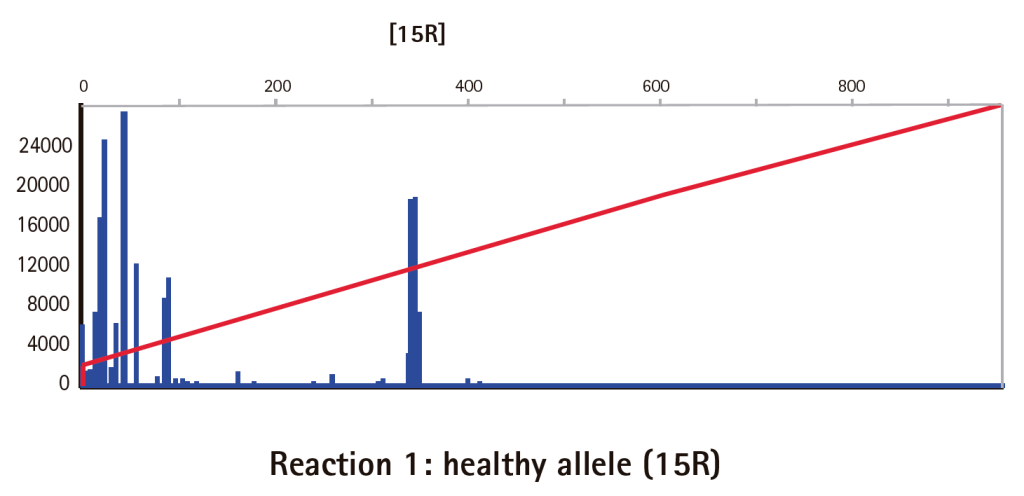
Adellgene Friedreich s Ataxia Reaction 1 healthy allele 15R
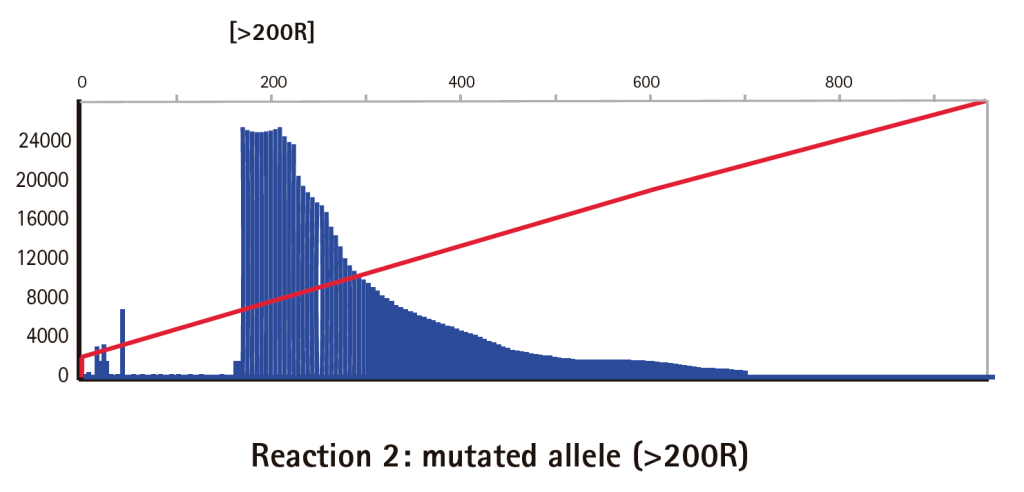
Adellgene Friedreich s Ataxia Reaction 2 mutated allele more than 200R
Adellgene Friedreich s Ataxia title
Adellgene® Friedreich’s Ataxia 5

Limitations

  • Mutations (point mutations, insertions, deletions) at amplification primer sites are possible and may result in the lack of allele definition. Other technologies could be necessary to resolve the genotyping.
  • Data and result interpretation should be revised by qualified personnel.

Area:

Molecular Genetics, Neurology, Targeted study of specific pathologies

Technology:

Documents:

Consult our experts

Google reCaptcha: Invalid site key.

Related products

Devyser LynchFAP

Devyser LynchFAP is a targeted NGS solution for the analysis of germline variants associated with hereditary colorectal cancer syndromes. The assay enables the detection of SNVs, indels, and CNVs in genes related to Lynch syndrome, familial adenomatous polyposis (FAP), and MUTYH-associated polyposis (MAP), also incorporating a specific LR-PCR for the correct localization of variants in…
Devyser
Next Generation Sequencing (NGS)

Devyser HBOC NGS

Devyser HBOC NGS is a fast and robust NGS solution aimed at the detection of germline variants in 12 genes associated with an increased risk of hereditary breast and ovarian cancer: ATM, BARD1, BRIP1, CDH1, CHEK2, NBN, PALB2, PTEN, RAD51C, RAD51D, STK11, TP53. It offers comprehensive and uniform coverage of all coding exons and exon/intron…
Devyser
Next Generation Sequencing (NGS)

Devyser BRCA NGS

Devyser BRCA NGS is a fast and robust NGS solution designed for the detection of genetic variants in the BRCA1 and BRCA2 genes. It offers comprehensive and uniform coverage of all coding exons and exon/intron junctions of both genes. In addition, it includes the detection of single nucleotide variants (SNVs), insertions/deletions (Indels), and copy number…
Devyser
Next Generation Sequencing (NGS)

Devyser BRCA PALB2 NGS

Devyser BRCA PALB2 NGS is a fast and robust NGS solution designed for the detection of genetic variants in the BRCA1, BRCA2, and PALB2 genes. It offers comprehensive and uniform coverage of all coding exons and exon/intron junctions of both genes. In addition, it includes the detection of single nucleotide variants (SNVs), insertions/deletions (Indels), and…
Devyser
Next Generation Sequencing (NGS)