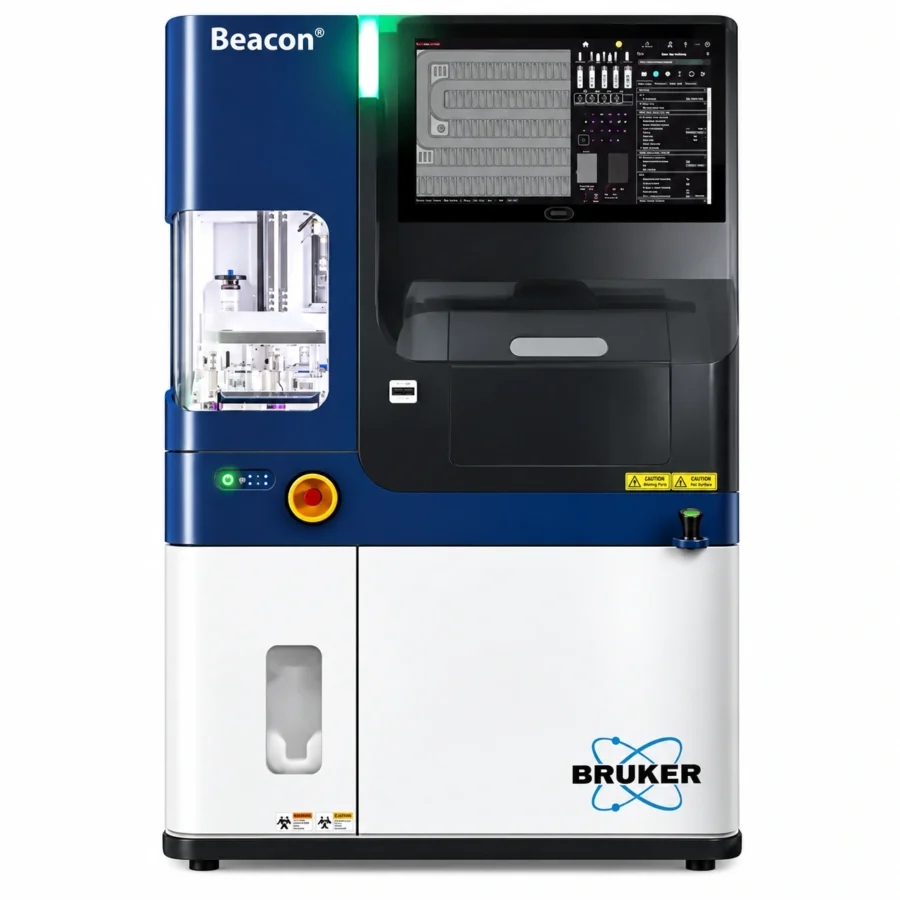
The Beacon® Optofluidic Suite represents an absolute revolution in cell biology and biotherapeutic development. By synergistically integrating advanced microfluidics, precision optics, optoelectronics and artificial intelligence, this platform enables the isolation, culture, characterization and recovery of thousands of individual cells in a fully automated manner and in real time.
Unlike traditional static or destructive methodologies, Bruker’s optoelectronic force (OEP) technology manipulates cells extremely gently using light, enabling multiple functional and kinetic parameters to be assessed in living cells and, subsequently, the highest-value clones to be recovered for subsequent sequencing or clonal expansion.
Key features
How does Beacon® work?
The Beacon® system redefines the study of cellular heterogeneity through a simplified, closed and automated workflow comprising four critical stages:
Cell loading and import
The cell suspension is automatically introduced into the main fluidic channels of the OptoSelect® chip. Using light directed by the optoelectronic system, thousands of individual cells are gently guided into the NanoPen® microchambers, where they remain physically isolated while maintaining constant diffusive exchange with the continuous perfusion medium.
On-chip culture and functional assays
Cells are incubated under controlled physiological conditions of temperature, gas and perfusion. The platform automatically performs multiple sequential dynamic assays on the same chip:
Automated data analysis with Cell Analysis Software (CAS)
The CAS (Cell Analysis Software) software suite processes and integrates optical and kinetic images in real time, generating multidimensional profiles that define the behavior of each individual cell. The system quantitatively associates complex phenotypes, cellular interactions and specific secretion indices.
Clonal selection and export
Based on the functional criteria defined by the researcher, the platform again uses optoelectronic force to export only the cells of interest—for example, high-affinity antibody-producing clones or highly cytotoxic active T cells—directly into standard molecular biology formats for subsequent molecular characterization or expansion.
Applications
Therapeutic antibody discovery

T-cell profiling and functionality

Cell Line Development
Equipment specifications
To meet the needs of each laboratory, Bruker’s optofluidic suite is available in two highly scalable configurations:
| Feature/configuration | Beacon® Optofluidic System | Beacon Discovery™ |
|---|---|---|
| Primary focus | Large-scale biotechnology and pharmaceutical industry, CDMOs and high-throughput screening centers. | Advanced translational research, immunology and academic antibody discovery. |
| Chip capacity | Parallel processing of up to 4 chips per run. | Optimized processing of 1 chip per run. |
| Cell capacity | Up to 160,000 individual NanoPens analyzable per run. | Up to 20,000 individual NanoPens analyzable per run. |
| Automation and workflow | Maximum robotic capacity, optimal for continuous 24/7 processes. | Compact, benchtop system designed for experimental flexibility. |