Opens in a new tab

Violet 3.0 & QF-Pro® Technology

Conventional spatial biology reveals where proteins are; Violet 3.0 and QF-Pro® technology reveal what they are doing. Most current proteomic assays are limited to measuring molecular expression levels, overlooking whether proteins are actually activated or interacting with one another. In critical fields such as immuno-oncology, neurobiology and drug development, the relationship between expression and the actual function of proteins is often uncoupled, greatly limiting the predictive value of conventional biomarkers and leading to the failure of numerous therapeutic strategies.

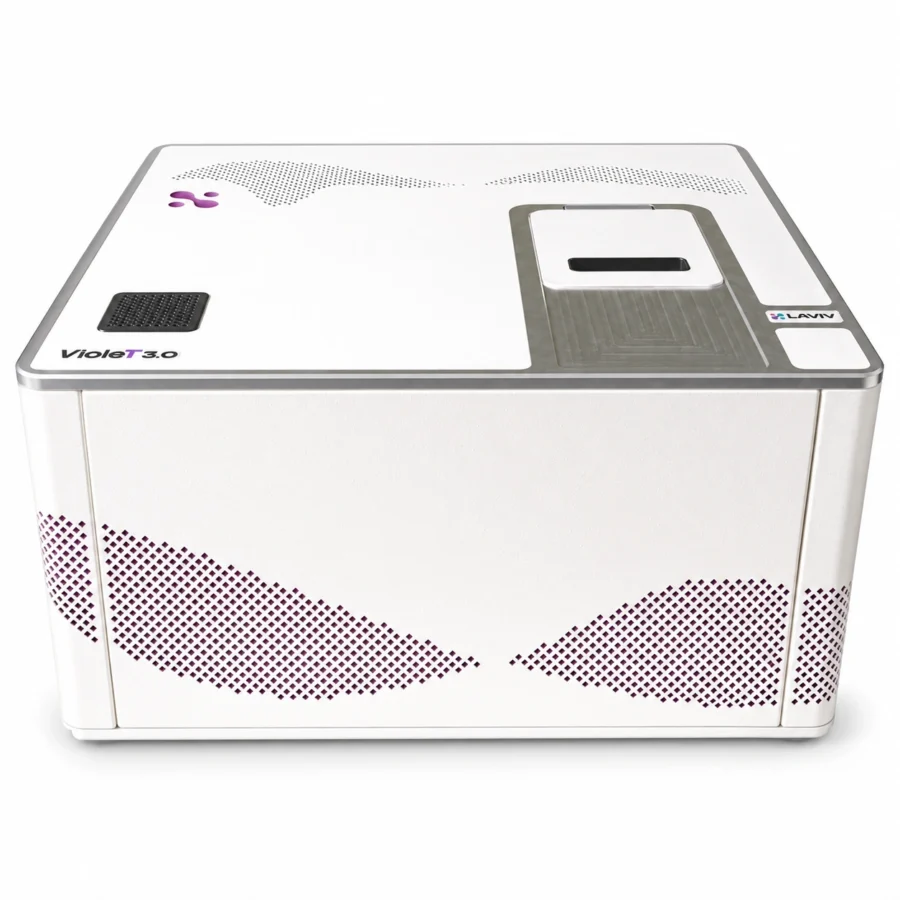
Violet 3.0 and QF-Pro technology

Developed by Hawk Biosystems, the patented QF-Pro® (Quantifying Functions in Proteins) technology is the first and only platform capable of spatially quantifying protein function in situ with nanoscale resolution below 10 nm, directly in complex biological samples such as formalin-fixed, paraffin-embedded (FFPE) tissues and cell cultures.

Through the all-in-one Violet 3.0 bioimaging system and its optimised reagent kits, QF-Pro® translates static expression profiles into dynamic maps of molecular function. By measuring protein-protein interactions (PPIs), post-translational modifications (PTMs) such as phosphorylation, and receptor activation states at the nanoscale, this solution provides a layer of functional information hidden from other omics technologies.

Key Features

True functional quantification at <10 nm: QF-Pro® operates as a molecular biochemical ruler, detecting genuine physical interactions and binding only when molecules are in direct contact (1–10 nm). It overcomes the limitations of proximity assays (PLA, ~40 nm) and conventional immunofluorescence colocalisation (~200 nm), which report spatial proximity but not genuine biological interaction.
Innovative signal amplification system: It incorporates patented signal amplification chemistry that completely overcomes the natural autofluorescence of clinical FFPE tissue, ensuring an optimal signal-to-noise ratio and unprecedented analytical sensitivity.
Benchtop “Plug-and-Play” bioimaging platform: The Violet 3.0 instrument dramatically simplifies FRET-FLIM microscopy. Designed for routine use in any laboratory, it removes the need for specialists in physics or complex optics through an intuitive, automated workflow.
Functional and phenotypic multiplexing: It enables the simultaneous characterisation of up to 4 biomarker expression profiles using standard immunofluorescence together with 1 high-resolution QF-Pro® functional map on the same tissue section.
Reproducible, clinically ready results: Because it is based on fluorescence lifetime imaging (FLIM)—an intrinsic physical parameter independent of fluorophore concentration or illumination intensity—the resulting QF-Pro® Score is highly quantitative, robust and directly comparable across different batches, laboratories and clinical cohorts.

How does it work?

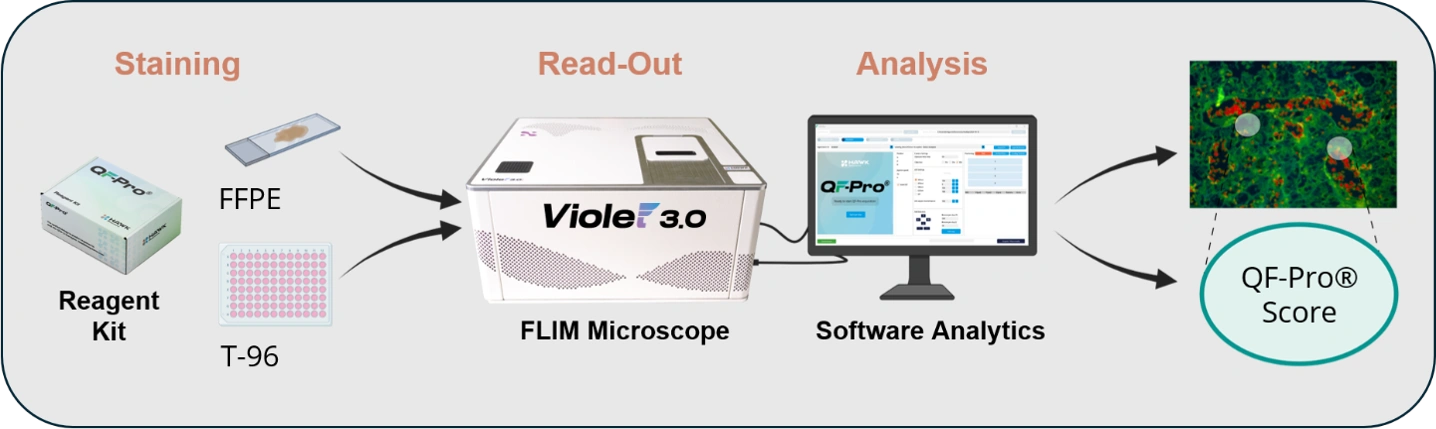
QF-Pro® technology is based on the combination of a two-site antibody binding assay, amplified Förster resonance energy transfer (FRET), and fluorescence lifetime imaging microscopy (FLIM).
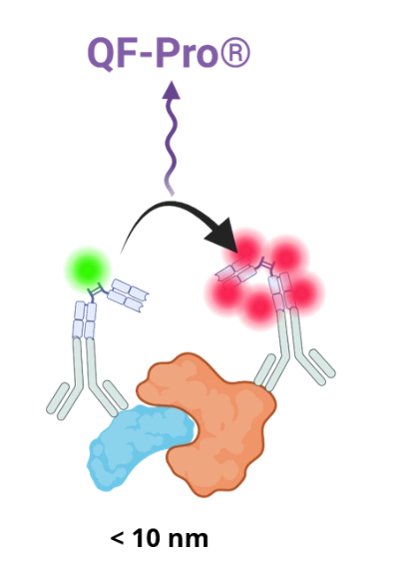
QF-Pro FRET-FLIM operating principle

FRET-FLIM Operating Principle:

1
Specific two-site labelling: Two primary antibodies from different species are used against two epitopes of interest, whether they are two interacting proteins or a protein and its post-translational modification site.
2
QF-Pro® secondary detection: Specific secondary antibodies coupled to a donor chromophore fluorophore (green) and an amplified chemical acceptor (red) are applied.
3
FRET Energy Transfer: If the epitopes are in genuine physical contact, at a distance of between 1 and 10 nm, non-radiative energy transfer occurs from the excited donor to the acceptor.
4
Fluorescence Lifetime Measurement (FLIM) in Violet 3.0: The instrument measures the decay of the donor fluorescence lifetime with picosecond precision. When FRET occurs, the donor lifetime is significantly reduced. Violet 3.0 scans the sample pixel by pixel to record this reduction.
5
Generation of the QF-Pro® Score: The proprietary software automatically calculates FRET efficiency in each region of interest (ROI), translating it into a continuous numerical value (Score) and a high-resolution spatial functional map without requiring manual curve adjustments or subjective interpretation.
QF-Pro Score and high-resolution spatial functional map

Technical Specifications

Parameter Violet 3.0 / Reagent Kits Specification
Measurement technology Amplified FRET-FLIM (Fluorescence Lifetime Imaging Microscopy using frequency modulation) with patented signal amplification chemistry.
Analytical resolution Strict nanoscale limits for molecular interactions between 1 and 10 nm.
Multiplexing capacity Up to 4 standard immunofluorescence channels for biomarker expression profiling + 1 QF-Pro® functional map in a single reading.
Supported sample formats Compatible with conventional glass slides, with capacity for up to 4 slides per load in an interchangeable holder, and standard multiwell plates for in vitro cell assays.
Excitation sources High-performance modulated laser for FLIM and a 4-way multichannel LED illumination system for conventional immunofluorescence.
Available objectives Equipped with high numerical aperture dry objectives at 10x, 20x and 40x.
Reagent kit performance Guaranteed stability for 6 months from receipt. Each kit includes optimised secondary reagents for processing up to 100 FFPE slides or 1 96-well plate.
Analysis software QF-Pro® software suite with an intuitive interface, automated ROI mapping, direct QF-Pro® Score calculation, application of clinical thresholds, and direct data export to Excel and visual reports to PowerPoint/PDF.
Maintenance Compact benchtop format. Free from maintenance, complex optical calibration, or the laser alignment consumables commonly required by conventional FLIM equipment.

Area:

Omics, Proteomics

Technology:

Consult our experts

Google reCaptcha: Invalid site key.

Related products

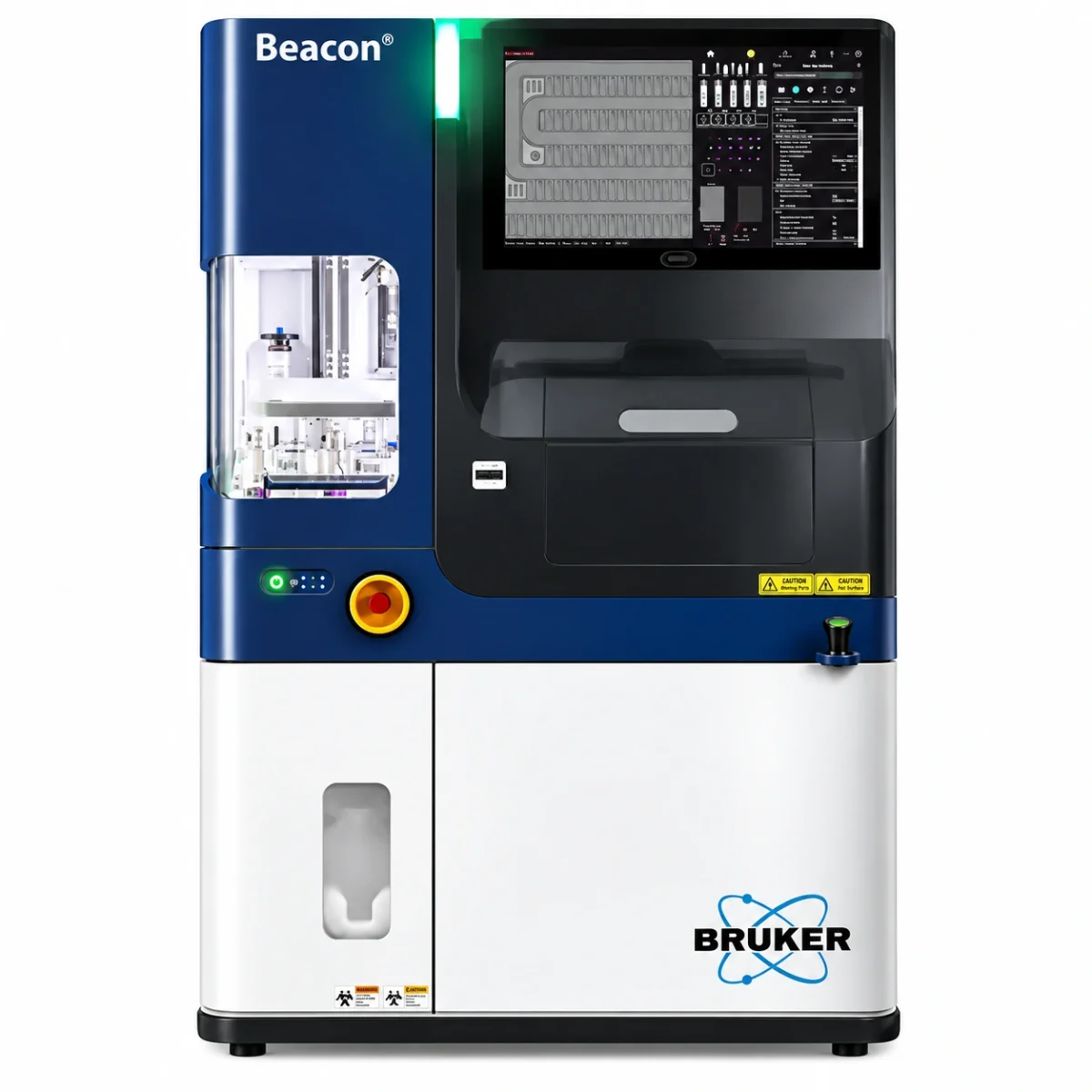
Beacon® Optofluidic Suite

The Beacon® Optofluidic Suite represents an absolute revolution in cell biology and biotherapeutic development. By synergistically integrating advanced microfluidics, precision optics, optoelectronics and artificial intelligence, this platform enables the isolation, culture, characterization and recovery of thousands of individual cells in a fully automated manner and in real time. Unlike traditional static or destructive methodologies, Bruker’s…
Bruker
Functional Assay

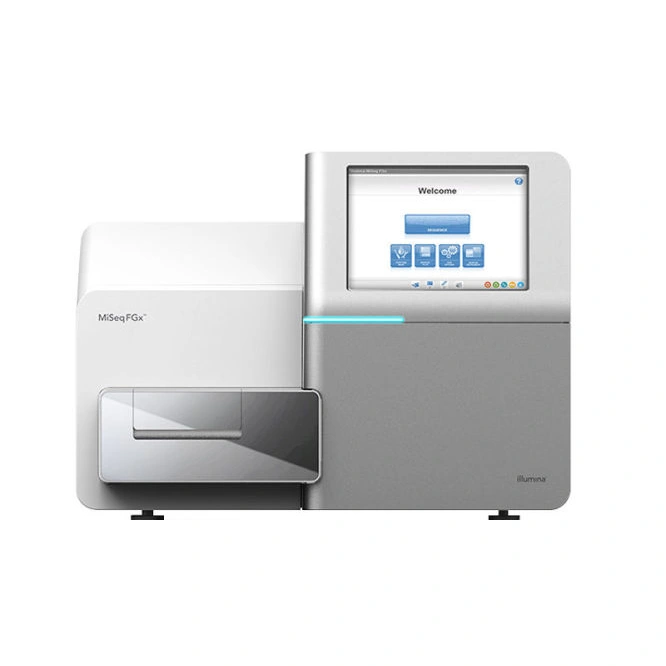
MiSeq FGx® Sequencing System and server with Universal Analysis Software (UAS)

MiSeq FGx is a benchtop sequencer designed for forensic genetics applications. Together with the dedicated server incorporating ForenSeq Universal Analysis Software (UAS), it enables users to configure runs, sequence libraries, analyse profiles and generate reports through a workflow adapted to forensic genetics applications. The application and type of report depend on the kit and the…
Qiagen
Next Generation Sequencing (NGS)

ForenSeq® DNA Signature PLUS Kit

ForenSeq® DNA Signature Plus Kit is a DNA library preparation kit using next-generation sequencing (Next-Generation Sequencing, NGS) for forensic genetics. It enables the analysis, in a single reaction, of STR and SNP markers intended for human identification, forensic case analysis, generation of profiles for databases and kinship testing. It includes two primer mixes to adapt…
Qiagen
Next Generation Sequencing (NGS)

NimoTest® Fetal RHD qPCR kit

NIMoTest® Fetal RHD qPCR kit is a kit for determining the fetal RHD genotype from maternal plasma. It is intended for the monitoring of RhD-negative pregnant women to guide anti-RhD immunoprophylaxis and adapt the monitoring of immunised women. Detailed description The kit is designed for duplex quantitative PCR (pPCR) amplification of exons 5 and 7…
BeDia Genomics
Real Time PCR (qPCR)