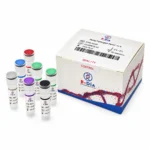
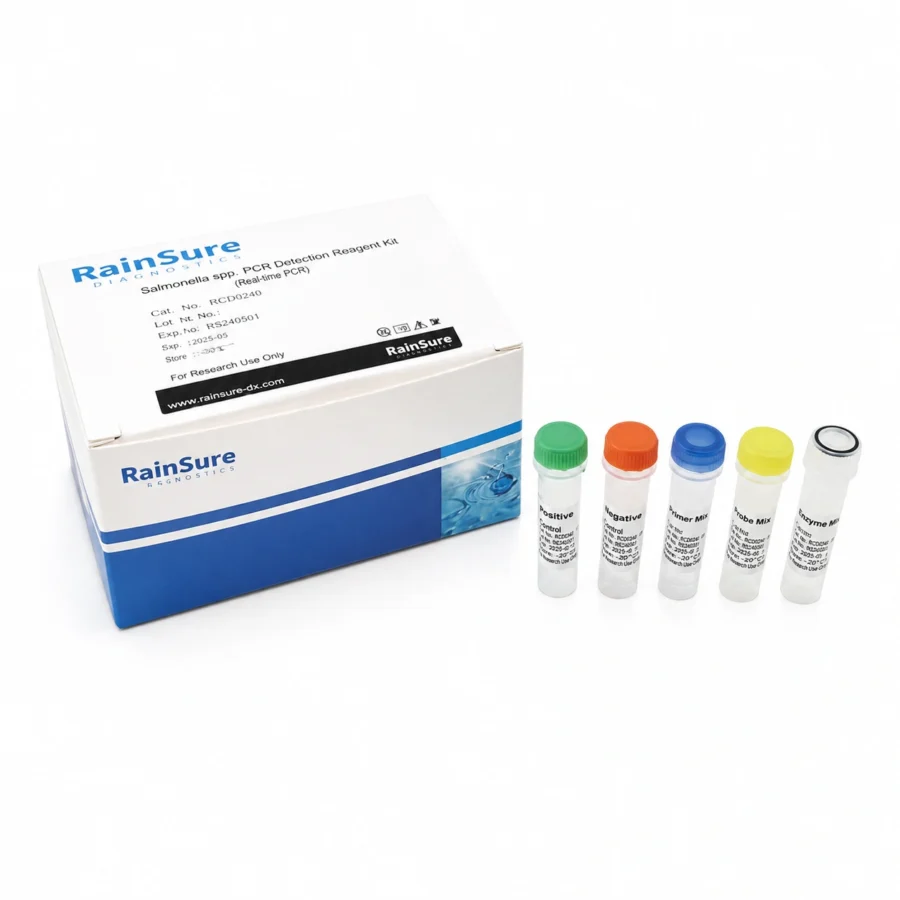
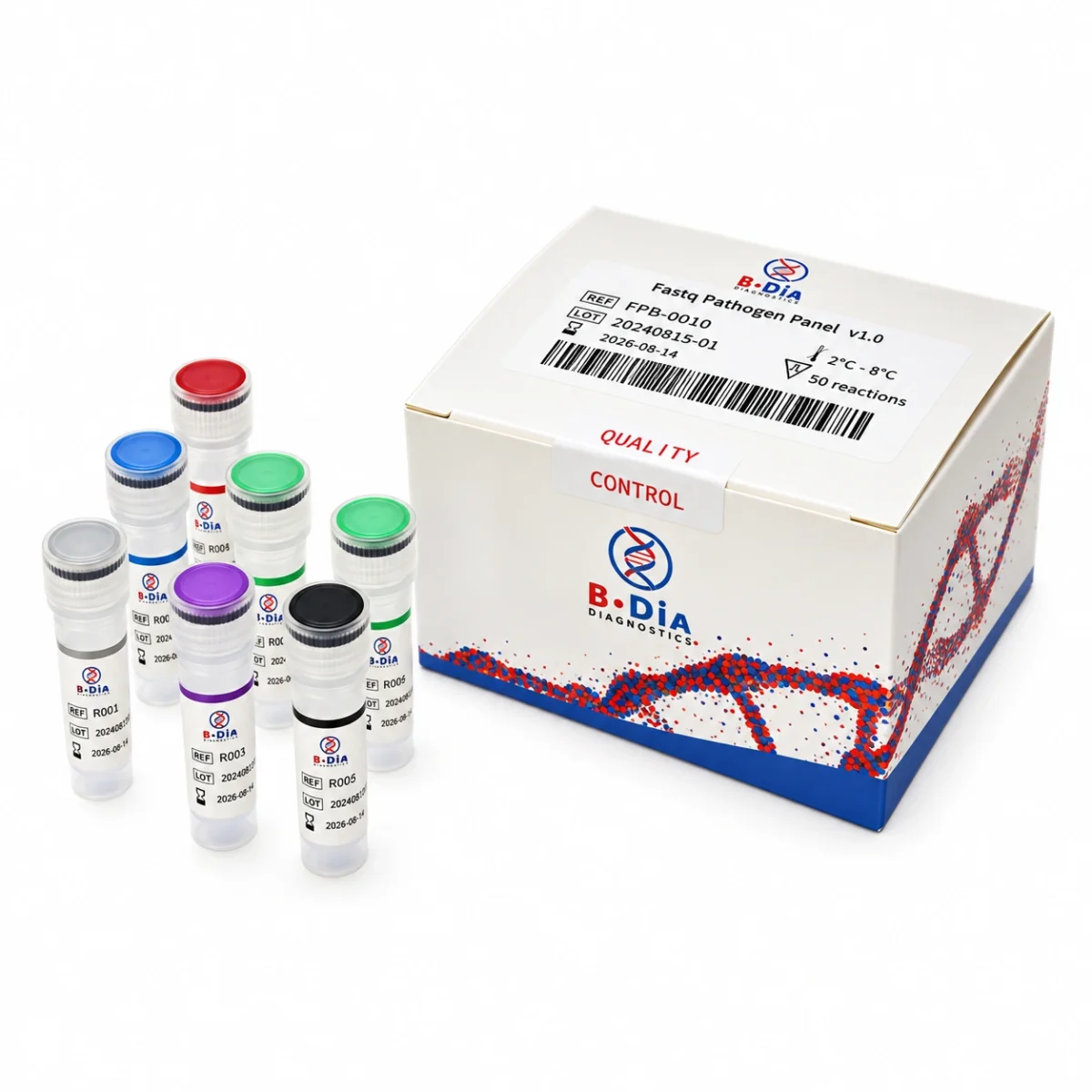
In vitro diagnostic kit based on droplet digital PCR (dPCR) for the detection of pathogenic microorganisms associated with sepsis from DNA extracted from clinical samples. The kit allows identification and quantification of pathogens without requiring blood culture, covering 21 frequent agents in bloodstream infections.
Detailed Description
Principle of operation
The Sepsis Pathogenic Microorganism Detection Kit (Digital PCR) uses droplet digital PCR technology combined with TaqMan fluorescent probes to detect specific gene fragments of different pathogenic microorganisms. Each target is identified by one‑ or two‑color fluorescent probes and, by combining probes in different proportions, the system allows simultaneous detection of multiple pathogens in a single well.
During the procedure, microbial DNA extracted from the sample is randomly distributed into thousands of oil‑encapsulated droplets inside the digital PCR cartridge. After amplification, the fluorescent signals from each droplet are analyzed using statistical methods based on Poisson distribution, allowing precise detection of the microorganisms present.
The assay is organized into two main mixtures or panels, Sepsis Buffer 1 and Sepsis Buffer 2, which are processed separately for each sample and for the controls. Each reaction has a final volume of 20 µl and includes enzyme mix, specific buffer, nuclease‑free water, and sample or control DNA.
Clinical applications
The kit is designed for the detection of various pathogens involved in sepsis, a life‑threatening condition caused by microbial invasion of the bloodstream. The documentation indicates that bloodstream infection is a precursor to sepsis and can be caused by bacteria, viruses, and fungi. The product allows identification of types and loads of pathogenic microorganisms in blood without the need for blood culture. 21 frequent pathogenic agents in bloodstream infections, including Gram‑negative bacteria, Gram‑positive bacteria, and fungi.
Detected microorganisms
The kit detects the following pathogens included in the two CE‑IVD panels:
Panel 1
Panel 2
Staphylococcus capitis
Acinetobacter baumannii
Candida tropicalis
Candida krusei
Staphylococcus epidermidis
Enterococcus faecium
Cryptococcus neoformans
Stenotrophomonas maltophilia
Klebsiella pneumoniae
Streptococcus pneumoniae
Serratia marcescens
Bacteroides fragilis
Escherichia coli
Candida parapsilosis
Candida glabrata
Enterobacter cloacae complex
Enterococcus faecalis
Haemophilus influenzae
Pseudomonas aeruginosa
Staphylococcus aureus
Candida albicans
Panel 2 also includes an internal control.
Benefits
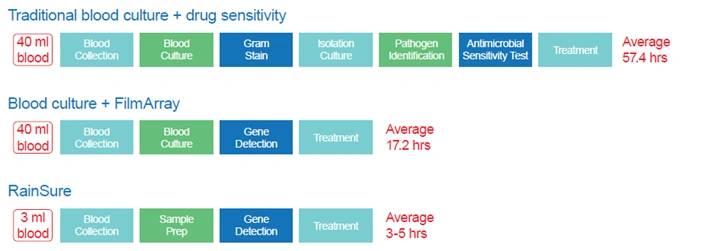
Allows direct molecular detection of sepsis‑associated pathogens by digital PCR, without relying on blood culture growth.Provides rapid and accurate identification of microbial nucleic acids in whole blood, aimed at facilitating faster and targeted treatment.The RainSure workflow allows working with 3 ml of blood and obtaining results in an average of 3‑5 hours.Offers absolute quantification, high sensitivity, and rapid detection, according to the technological comparison included in the technical documentation.Allows detection of co‑infections and multiple pathogens in the same sample, according to the product technical description.
Key results or indicators
Interpretation of results is based on the count of positive droplets relative to the Limit of Blank (LoB) defined for each target. For all pathogens included in the panels, the indicated positive value is ≥3 positive droplets.
If the number of positive droplets for a target exceeds the LoB, the sample is reported as positive for that pathogen.If the number of positive droplets is below the LoB, the sample is reported as negative.If the number of positive droplets equals the LoB, it is recommended to repeat the assay with the maximum sample volume; if the repeat exceeds the LoB, the pathogen is reported as positive.
Technology used
The product is based on droplet digital PCR with multi‑channel fluorescent detection. The compatible system indicated in the IFU is the RainSure DropX‑2250 series digital PCR system, with five fluorescence channels: FAM, HEX, ROX, Cy5, and Cy5.5.
Intended user / audience
Qualified laboratory personnel trained in dPCR techniques.
Considerations or limitations
The kit is intended for in vitro diagnostic (IVD) use.Results may be affected by sample collection, handling, transport, and storage.Cross‑contamination can produce false positives.Inadequate collection, transport, or handling can generate false negatives.Variations in the analyzed target sequences can also cause false negatives.Use is restricted to the indicated sample types and analysis systems, including instrumental models, nucleic acid extraction reagents, and applicable methods.
Key Features
IVD kit for detection of sepsis‑associated pathogens.
Droplet digital PCR technology with TaqMan probes.
Detection of 21 frequent microorganisms in bloodstream infections.
Includes Gram‑positive bacteria, Gram‑negative bacteria, and fungi.
Allows detection without blood culture.
Compatible with RainSure DropX‑2250 system.
Multi‑channel analysis: FAM, HEX, ROX, Cy5, and Cy5.5.
Interpretation based on positive droplets and LoB ≥3.
Average time indicated in technical literature: 3‑5 hours.
Allows absolute quantification and detection of multiple pathogens in the same sample.
Sepsis Buffer 1: 1 vial of 210 µl. Contains dNTPs, MgCl₂, KCl, Tris‑HCl, and primers/probes for Panel 1 pathogens.Sepsis Buffer 2: 1 vial of 210 µl. Contains dNTPs, MgCl₂, KCl, Tris‑HCl, primers/probes for Panel 2 pathogens, and internal control primers/probes.Enzyme Mix: 1 vial of 60 µl, with Taq DNA polymerase.Sepsis Positive Control: 1 vial of 160 µl, with plasmids corresponding to the kit targets and internal control.Sepsis Negative Control: 1 vial of 160 µl, DNase/RNase‑free water.
Storage conditions
Store protected from light at a temperature below -15 °C.Shelf life: 12 months.Avoid more than 7 freeze/thaw cycles.
Sample types
The IFU indicates the following sample types:
Peripheral blood with EDTA anticoagulant.Sputum.Bronchoalveolar lavage.Cerebrospinal fluid.Pleural and abdominal fluid.Urine.Pus.
Required materials not included
RainSure Droplet Generation Oil for probes.RainSure Digital PCR Cartridge.RainSure Sealing Covers.Nuclease‑free water.Filter tips.Low‑binding, nuclease‑free centrifuge tubes.Pipette, centrifuge, and vortex.