Principle of Operation
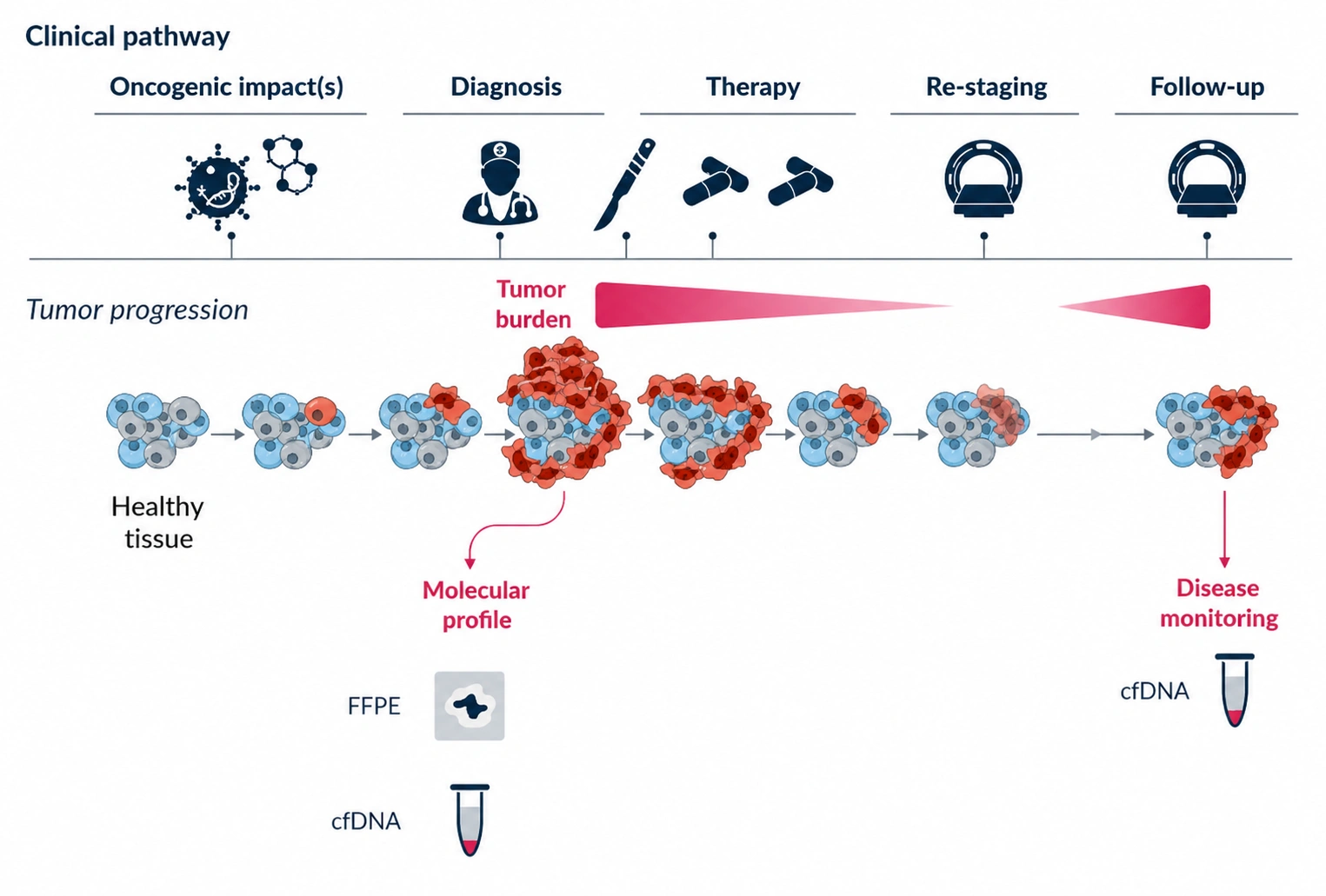
SOPHiA DDM™ for Liquid Biopsy comprises a set of solutions directly adapted from existing commercial applications for formalin-fixed paraffin-embedded (FFPE) tissue, enabling the analysis of circulating cell-free DNA (cfDNA) in plasma.
The incorporation of unique molecular identifiers (UMIs) through CUMIN™ enables the generation of ultra-deep duplex consensus sequences. This process effectively suppresses analytical sequencing noise and corrects errors accumulated during PCR amplification, ensuring reliable detection of variants at extremely low allele frequencies (with a limit of detection of up to 0.5% VAF) using a minimum input of only 20 ng of cfDNA.
This portfolio comprises 3 solutions:
| Adapted Solution | No. of Genes | Cancer Type / Indications | Complete List of Interrogated Genes |
|---|---|---|---|
|
LBx STS (Solid Tumor Solution) |
42 | Lung cancer, melanoma, colorectal cancer, thyroid cancer, GIST and glioma in cfDNA. | AKT1, ALK, BRAF, CDK4, CDKN2A, CTNNB1, DDR2, DICER1, EGFR, ERBB2, ERBB4, FBXW7, FGFR1, FGFR2, FGFR3, FOXL2, GNA11, GNAQ, GNAS, H3F3A, H3F3B, HIST1H3B, HRAS, IDH1, IDH2, KIT, KRAS, MAP2K1, MET, MYOD1, NRAS, PDGFRA, PIK3CA, PTPN11, RAC1, RAF1, RET, ROS1, SF3B1, SMAD4, TERT, TP53 |
|
LBx HRS (Homologous Recombination Solution) |
16 | Ovarian, prostate, breast and other cancers associated with homologous recombination repair (HRR). | ATM, BARD1, BRCA1, BRCA2, BRIP1, CDK12, CHEK1, CHEK2, FANCL, PALB2, PPP2R2A, RAD51B, RAD51C, RAD51D, RAD54L, TP53 |
|
LBx ExtHRS (Extended HRS) |
28 | Expanded profiling of genes involved in the HRR pathway (breast, ovarian and endometrial cancer). | AKT1, ATM, BARD1, BRCA1, BRCA2, BRIP1, CCNE1, CDK12, CHEK1, CHEK2, ESR1, FANCA, FANCD2, FANCL, FGFR1, FGFR2, FGFR3, MRE11, NBN, PALB2, PIK3CA, PPP2R2A, PTEN, RAD51B, RAD51C, RAD51D, RAD54L, TP53 |
Clinical Applications
This tool is intended for the non-invasive molecular profiling of solid tumors using liquid biopsy (cfDNA) in oncology research workflows and longitudinal variant monitoring.
It enables accurate assessment of tumor clonal evolution, early detection of acquired resistance mechanisms and characterization of clinically actionable biomarkers when adequate or representative tumor tissue is not available.
The portfolio specializes in translating SOPHiA GENETICS’ traditional tissue applications to liquid biopsy, providing the flexibility to study the same targeted genomic regions using plasma cfDNA samples instead of difficult-to-access FFPE tissue.
Benefits
Intended Users
Molecular genetics and translational oncology laboratories that already perform or wish to implement NGS-based solid tumor analysis and seek to transfer their routine tissue assays to liquid biopsy using an integrated workflow from sample to report on the SOPHiA DDM™ platform.