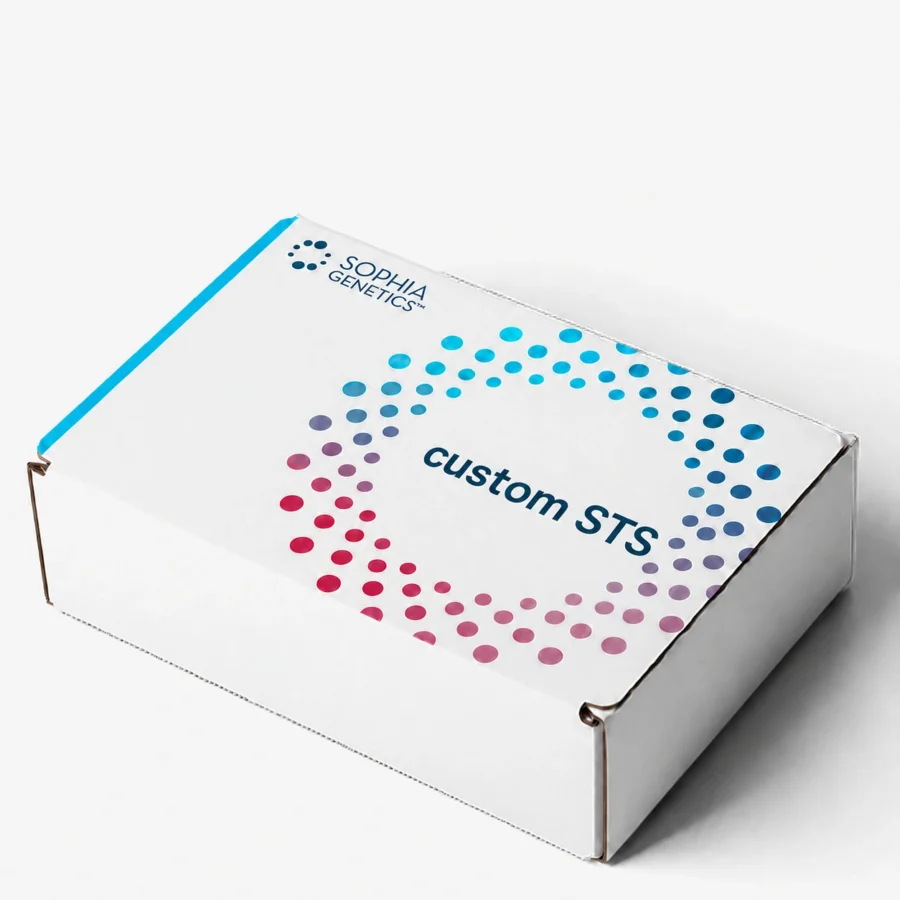
A portfolio of pre-designed and optimised NGS solutions based on hybrid-capture technology for comprehensive analysis of biomarkers associated with solid tumours from DNA and RNA. Designed by genomic experts to simplify in-house implementation and accelerate cancer research, these applications integrate natively with the analytical and interpretative capabilities of the cloud-based SOPHiA DDM™ platform.
They provide excellent coverage uniformity and on-target rates for the detection of SNVs, Indels, CNVs, MSI and RNA fusions, reducing design and validation times through standardised wet-lab workflows: 1.5 days for DNA and 2 days for DNA+RNA.
Detailed description
Principle of operation
The cSTS solutions comprise a versatile range of targeted hybrid-capture panels designed to adapt to the requirements of each laboratory.
The protocol can be flexibly adapted to each laboratory’s analytical requirements. It uses Universal Library Prep with a minimum DNA input of only 10 ng and a recommended input of 50 ng.
For laboratories requiring comprehensive molecular profiling and interpretation, the Plus (DNA & RNA) versions simultaneously integrate RNA/cDNA library preparation with an equivalent minimum input of 10 ng and a recommended input of 50 ng. The wet-lab workflow is physically combined from the hybridisation and pooled capture enrichment stage onwards.
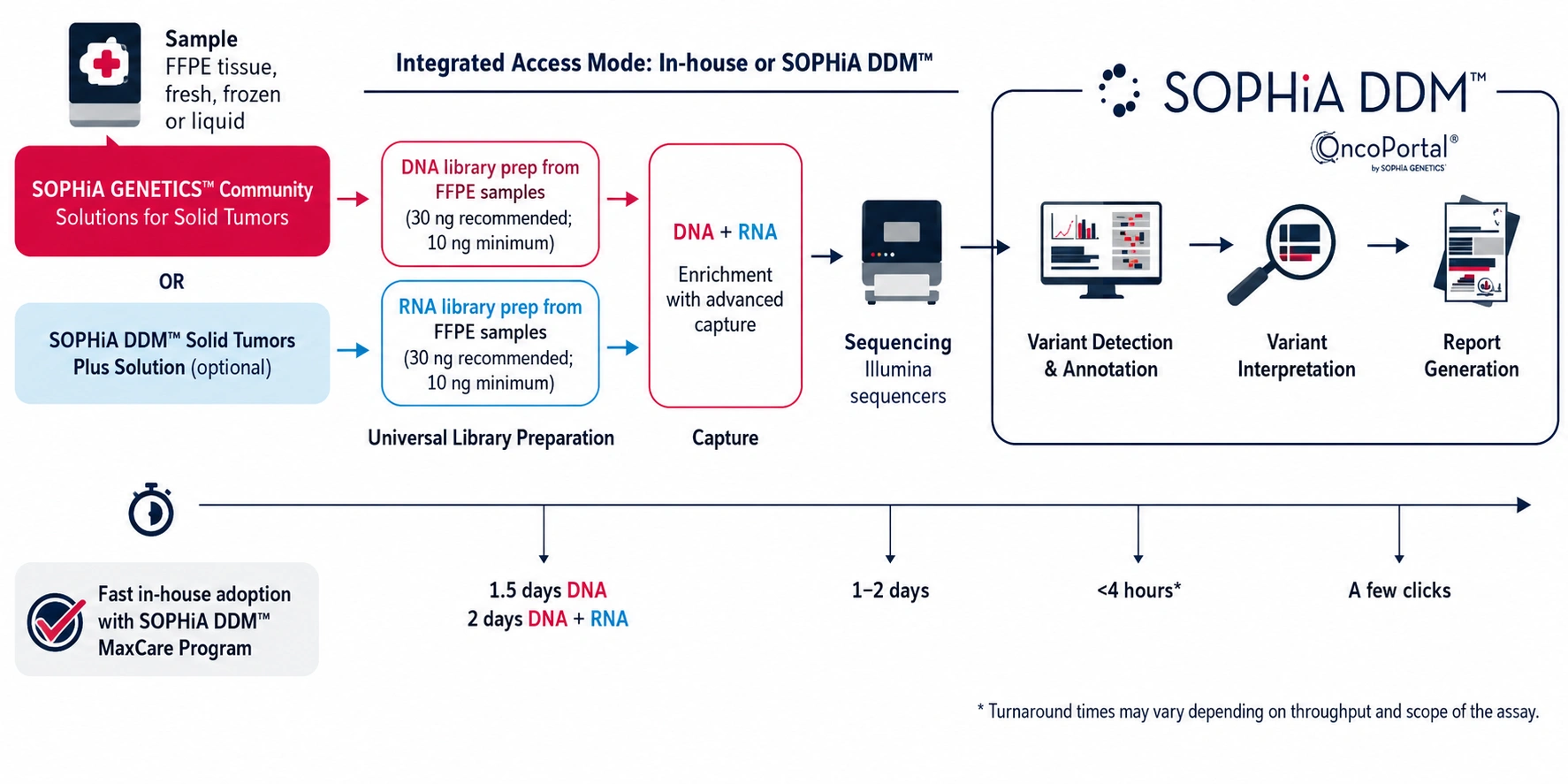
Raw data are analysed fully automatically on the SOPHiA DDM™ platform. The solution provides deep molecular annotation and pathogenicity pre-classification according to AMP/ASCO/CAP guidelines. The variant viewer supports virtual panels and cascading filters, allowing the analysis to focus exclusively on variants with clinical or biological relevance to the disease under investigation.
This portfolio comprises six different kits:
| Panel | No. of genes | Tumour types | Complete gene list |
|---|---|---|---|
| SOPHiA DDM™ Solid Tumor Solution (STS) | 42 | Lung, melanoma, colorectal, thyroid, GIST and glioma. | AKT1, ALK, BRAF, CDK4, CDKN2A, CTNNB1, DDR2, DICER1, EGFR, ERBB2, ERBB4, FBXW7, FGFR1, FGFR2, FGFR3, FOXL2, GNA11, GNAQ, GNAS, H3F3A, H3F3B, HIST1H3B, HRAS, IDH1, IDH2, KIT, KRAS, MAP2K1, MET, MYOD1, NRAS, PDGFRA, PIK3CA, PTPN11, RAC1, RAF1, RET, ROS1, SF3B1, SMAD4, TERT and TP53. |
| CSTS_49 | 49 | In addition to STS: endometrial cancer. | AKT1, ALK, BRAF, CDK4, CDKN2A, CTNNB1, DDR2, DICER1, EGFR, ERBB2, ERBB3, ERBB4, ESR1, FBXW7, FGFR1, FGFR2, FGFR3, FOXL2, GNA11, GNAQ, GNAS, H3F3A, H3F3B, HIST1H3B, HRAS, IDH1, IDH2, KEAP1, KIT, KRAS, MAP2K1, MED12, MET, MYOD1, NRAS, PDGFRA, PIK3CA, POLE, PTEN, PTPN11, RAC1, RAF1, RET, ROS1, SF3B1, SMAD4, STK11, TERT and TP53. |
| CSTS_51 | 51 | In addition to STS: endometrial cancer. | AKT1, ALK, ARID1A, BRAF, BRCA1, BRCA2, CDK4, CDKN2A, CTNNB1, DDR2, DICER1, EGFR, ERBB2, ERBB4, ESR1, FBXW7, FGFR1, FGFR2, FGFR3, FOXL2, GNA11, GNAQ, GNAS, H3F3A, H3F3B, HIST1H3B, HRAS, IDH1, IDH2, KIT, KMT2A, KMT2D, KRAS, MAP2K1, MAP2K2, MET, MTOR, MYOD1, NRAS, PDGFRA, PIK3CA, PTPN11, RAC1, RAF1, RET, ROS1, SF3B1, SMAD4, TERT, TGFBR2 and TP53. |
| CSTS_55 | 55 | In addition to STS: breast and ovarian cancer. | AKT1, ALK, ARID1A, ARID5B, BRAF, BRCA1, BRCA2, CDK4, CDKN2A, CTCF, CTNNB1, DDR2, DICER1, EGFR, ERBB2, ERBB4, FBXW7, FGFR1, FGFR2, FGFR3, FOXL2, GNA11, GNAQ, GNAS, H3F3A, H3F3B, HIST1H3B, HRAS, IDH1, IDH2, KEAP1, KIT, KRAS, MAP2K1, MET, MYOD1, NF1, NRAS, PDGFRA, PIK3CA, PIK3R1, POLE, PPP2R1A, PTEN, PTPN11, RAC1, RAF1, RET, ROS1, RPL22, SF3B1, SMAD4, STK11, TERT and TP53. |
| CSTS_57 | 57 | In addition to STS: breast, ovarian and endometrial cancer. | AKT1, ALK, ARID1A, ARID5B, BRAF, BRCA1, BRCA2, CDK4, CDKN2A, CTCF, CTNNB1, DDR2, DICER1, EGFR, ERBB2, ERBB4, ESR1, FBXW7, FGFR1, FGFR2, FGFR3, FOXL2, GNA11, GNAQ, GNAS, H3F3A, H3F3B, HIST1H3B, HRAS, IDH1, IDH2, KEAP1, KIT, KRAS, MAP2K1, MET, MYOD1, NF1, NRAS, PDGFRA, PIK3CA, PIK3R1, POLD1, POLE, PPP2R1A, PTEN, PTPN11, RAC1, RAF1, RET, ROS1, RPL22, SF3B1, SMAD4, STK11, TERT and TP53. |
| CSTS_106 | 106 | In addition to STS: breast, ovarian and endometrial cancer. | AKT1, ALK, AR, ARAF, ARID1A, ARID2, ATM, ATRX, B2M, BAP1, BARD1, BRAF, BRCA1, BRCA2, BRIP1, CARD11, CCND1, CCNE1, CDK12, CDK4, CDK6, CDKN2A, CDKN2B, CHEK1, CHEK2, CTNNB1, DAXX, DDR2, EGFR, EIF1AX, ERBB2, ERBB3, ERBB4, ERCC2, ESR1, EZH2, FANCA, FANCL, FBXW7, FGFR1, FGFR2, FGFR3, GATA3, GNA11, GNAQ, GNAS, H3F3A, HIST1H3B, HRAS, IDH1, IDH2, JAK1, JAK2, KDM6A, KEAP1, KIT, KMT2C, KRAS, MAP2K1, MAP2K2, MAP3K1, MC1R, MDM2, MET, MITF, MTOR, MYC, MYCN, NBN, NCK1, NF1, NOTCH1, NOTCH2, NRAS, NTRK1, NTRK3, PALB2, PBRM1, PDGFRA, PIK3CA, PIK3R1, POLD1, POLE, PPP2R2A, PTCH1, PTEN, PTPN11, RAC1, RAD51B, RAD51C, RAD51D, RAD54L, RAF1, RB1, RET, RICTOR, ROS1, SF3B1, SMAD4, SMARCA4, STK11, TERT, TP53, TSC1, TSC2 and VHL. |
Modular RNA fusion detection
Plus add-on
The SOPHiA DDM™ Solid Tumor Plus Solution products incorporate probes for the targeted detection of a curated catalogue of 143 key RNA gene-fusion pairs, as well as MET exon 14 skipping events and the EGFR vIII variant.
Clinical applications
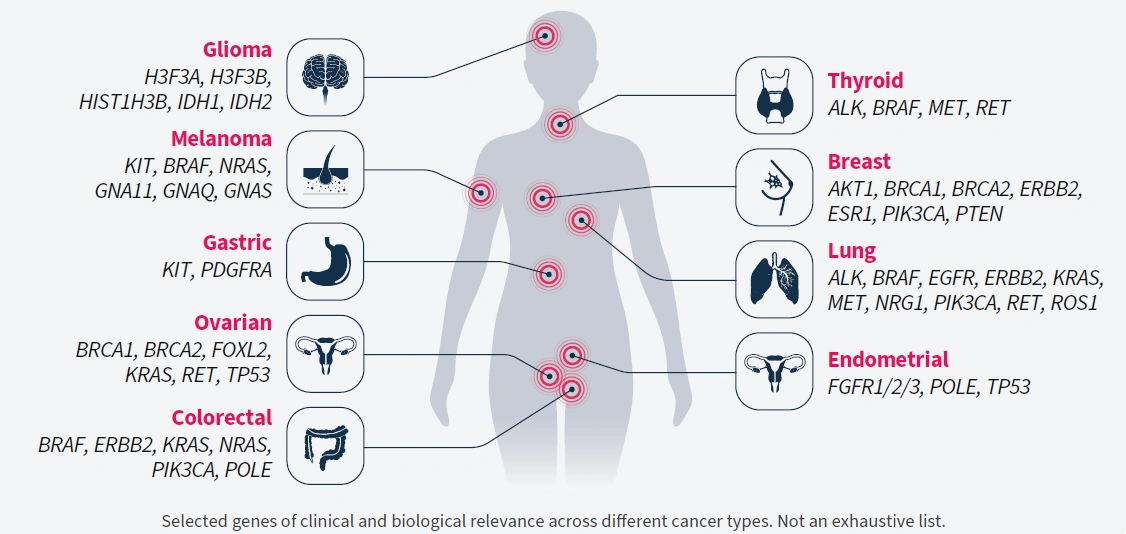
The backbone panel, Solid Tumor Solution – STS, provides robust coverage of the most frequent genomic variants in lung, colorectal, melanoma, thyroid, gastrointestinal stromal tumour (GIST) and glioma.
The Community Solutions – CSTS extend this coverage through curated gene designs for indications with high biological relevance, including endometrial, breast and ovarian cancer, or combinations of these, depending on the panel selected.
Benefits
Laboratories can choose from six pre-designed and tested panels of increasing size, ranging from 42 to 106 genes. Combined RNA-fusion detection can be added through the Plus versions, and genomic content can be customised by removing or adding genes according to laboratory requirements.
The complete sample-to-clinical-report workflow can be adopted locally, retaining sample ownership and data sovereignty through SOPHiA DDM™.
Compatible with automation on leading liquid-handling systems used in the industry.
Intended users
Clinical genetics and molecular oncology laboratories involved in the diagnosis, management and therapeutic decision-making of patients with solid tumours.
Key features
Product details
Solution type: bundle solution comprising wet-lab reagents and analytical credits for the cloud-based SOPHiA DDM™ web platform.
Sample type: DNA and RNA/cDNA from FFPE, fresh or frozen tissue samples.
Main solutions and product codes
| Solution / panel | Internal reference | Genes | Associated diseases | Panel size | Reads / sample | Product codes |
|---|---|---|---|---|---|---|
| SOPHiA DDM™ Solid Tumor Solution (STS) | STT | 42 | Lung, melanoma, colorectal, thyroid, GIST and glioma. | 21.6 Kb | 2.1 M |
DNA: BS0105ILLRSM Plus (DNA&RNA): BS0115ILLRSM |
| CSTS_49 | CSTS_L_v1 | 49 | In addition to STS: endometrial cancer. | 29.5 Kb | 3.0 M |
DNA: CS2479ILLRSM Plus (DNA&RNA): CS2490ILLRSM |
| CSTS_51 | CSTS_A_v1 | 51 | In addition to STS: endometrial cancer. | 44.0 Kb | 3.7 M |
DNA: CS2155ILLRSM Plus (DNA&RNA): CS2443ILLRSM |
| CSTS_55 | CSTS_N_v2 | 55 | In addition to STS: breast and ovarian cancer. | 77.0 Kb | 6.6 M |
DNA: CS2505ILLRSM Plus (DNA&RNA): CS2541ILLRSM |
| CSTS_57 | CSTS_N_v3 | 57 | In addition to STS: breast, ovarian and endometrial cancer. | 83.6 Kb | 8.3 M |
DNA: CS2552ILLRSM Plus (DNA&RNA): CS2603ILLRSM |
| CSTS_106 | CLSO_v5 | 106 | In addition to STS: breast, ovarian and endometrial cancer. | 324.0 Kb | 21.0 M |
DNA: CS2429ILLRSM Plus (DNA&RNA): CS2515ILLRSM |