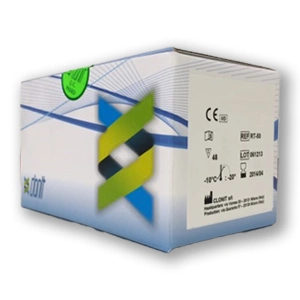
In vitro diagnostic kit based on real-time PCR for the qualitative detection of the ApoE*E2, ApoE*E3 and ApoE*E4 alleles in human genomic DNA.
Detailed Description
Operating principle
The kit is based on the specific amplification of target sequences by Real-Time PCR, using specific fluorescent probes.
Allelic discrimination is performed using labelled probes:
FAM (6-carboxyfluorescein) to detect cysteine (Cys)
HEX (hexachlorofluorescein) to detect arginine (Arg)
The fluorescent signal emitted during amplification makes it possible to identify the amino acid substitutions corresponding to the ApoE*E2, E3 and E4 alleles.
Clinical applications
Genotyping of the ApoE gene in human samples.
Assessment of the genetic risk associated with Alzheimer’s disease (AD).
Support for studies on lipid metabolism and neurodegenerative diseases.
Potential utility in predicting response to treatments (e.g. response to anticholinesterase drugs according to ApoE genotype).
Results or key indicators
Qualitative identification of the alleles:
ApoE*E2 (Cys112-Cys158)
ApoE*E3 (Cys112-Arg158)
ApoE*E4 (Arg112-Arg158)
Genotype determination:
Homozygous: E2/E2, E3/E3, E4/E4
Heterozygous: E2/E3, E2/E4, E3/E4
Technology used
Real-time PCR (Real-Time PCR)
Specific fluorogenic probes (TaqMan®-type technology)
Multichannel detection (FAM / HEX)
Compatible with multiple platforms:
Rotor-Gene® Q (Qiagen)
CFX96 / Opus (Bio-Rad)
Applied Biosystems® 7500
ELITe InGenius® and ELITe BeGenius®
Key Aspects
Specific detection of the ApoE E2, E3 and E4 alleles.
Technology based on Real-Time PCR with fluorescent probes.
High specificity through allelic discrimination (FAM/HEX).
Compatible with multiple real-time PCR platforms.
Includes positive controls (wild type and mutant) and a negative control.
Applicable to Alzheimer’s disease risk studies.
Ready-to-use format.
Presentation Details
Kit format: 32 tests (ref. EER018032)
Contents:
Amplification mixes (aa112 and aa158)
Oligonucleotide mixes (aa112 and aa158)
Control 1 (Cys, wild type)
Control 2 (Arg, mutant)
Reaction blank (BM)
Configuration:
Two separate boxes (aa112 and aa158)
Reaction volume: 25 µl
Required DNA: 100–250 ng per reaction
Capacity:
Up to 32 determinations
Validated for use in multiple sessions
Storage conditions:
-22°C to -18°C
Maximum of 6 freeze/thaw cycles
Sample type: Peripheral blood in EDTA