Homologous Recombination Solutions (HRS)

Portfolio of hybrid capture-based NGS solutions for the analysis of genes involved in homologous recombination repair (HRR) and the study of alterations associated with the homologous recombination pathway in different types of cancer. The range includes three scalable panels designed to meet different analytical needs: mini HRS, HRS and Extended HRS (ExtHRS).

Detailed description

Operating principle

Comprehensive solution based on hybrid capture technology for the targeted analysis of genes involved in the homologous recombination repair (HRR) pathway.
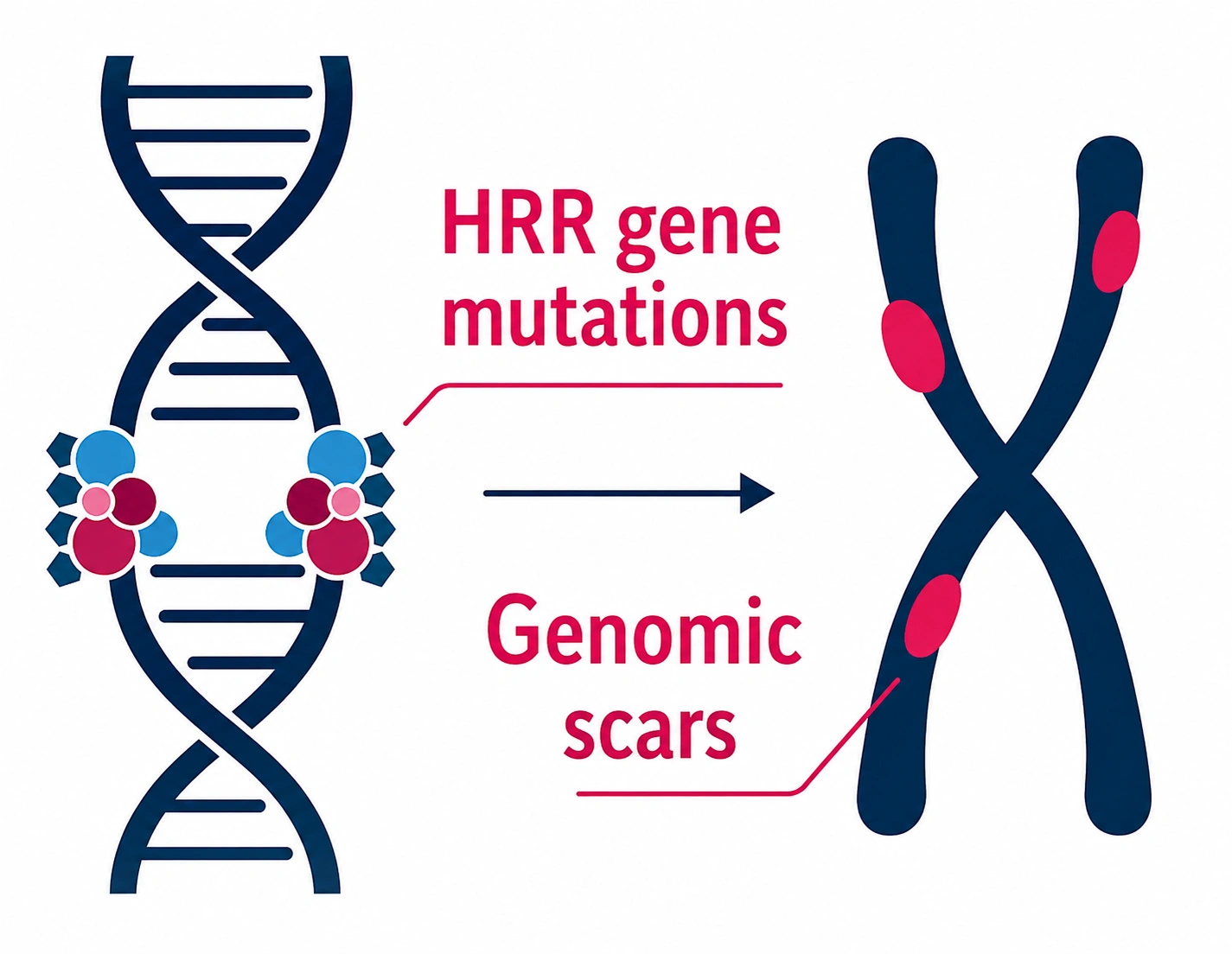
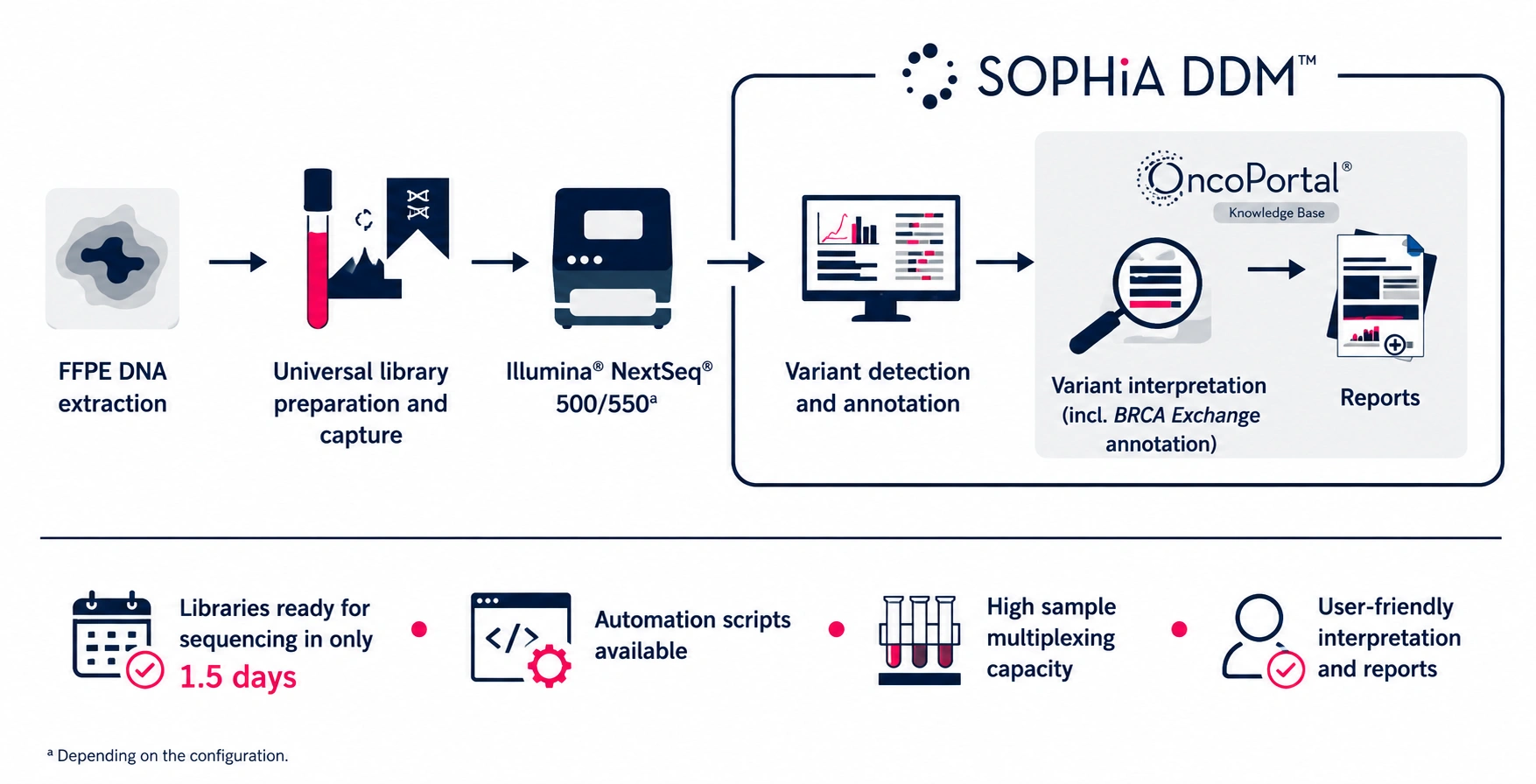
Operating principle of the SOPHiA DDM HRS solutions

The assay provides an efficient workflow starting with a recommended input of 50 ng of DNA extracted from formalin-fixed, paraffin-embedded (FFPE) tumour tissue or fresh-frozen tissue. Library preparation produces sequencing-ready libraries in just 1.5 days, with an automation option and minimal hands-on time.

The portfolio can be flexibly scaled across three capture-panel configurations according to the laboratory’s objectives:

Feature mini HRS HRS Extended HRS (ExtHRS)
Genes included 4 genes
BRCA1, BRCA2, RAD51C, TP53
16 genes
ATM, BARD1, BRCA1, BRCA2, BRIP1, CDK12, CHEK1, CHEK2, FANCL, PALB2, PPP2R2A, RAD51B, RAD51C, RAD51D, RAD54L, TP53
28 genes
AKT1*, ATM, BARD1, BRCA1, BRCA2, BRIP1, CCNE1, CDK12, CHEK1, CHEK2, ESR1*, FANCA, FANCD2, FANCL, FGFR1*, FGFR2*, FGFR3*, MRE11, NBN, PALB2, PIK3CA*, PPP2R2A, PTEN, RAD51B, RAD51C, RAD51D, RAD54L, TP53
Sample type FFPE, fresh-frozen tissue FFPE, fresh-frozen tissue FFPE, fresh-frozen tissue
DNA input 50 ng recommended 50 ng recommended 50 ng recommended
Reads per sample (2×150 bp) 1.6 million 4.7 million 8 million
Compatible sequencing platforms
Illumina MiSeq® (v3) Illumina MiSeq® (v2) Ion Torrent™ Ion S5™ System
Illumina MiniSeq™ Illumina MiSeq® (v3) Illumina MiSeq® (v2)
Illumina® NextSeq® 500/550a
Also compatible with NovaSeq® sequencers
mini HRS
Genes included 4 genes: BRCA1, BRCA2, RAD51C, TP53
Sample type FFPE, fresh-frozen tissue
DNA input 50 ng recommended
Reads per sample 1.6 million (2×150 bp)
Compatible platforms
Illumina MiSeq® (v3) Illumina MiSeq® (v2) Ion Torrent™ Ion S5™ System
HRS
Genes included 16 genes: ATM, BARD1, BRCA1, BRCA2, BRIP1, CDK12, CHEK1, CHEK2, FANCL, PALB2, PPP2R2A, RAD51B, RAD51C, RAD51D, RAD54L, TP53
Sample type FFPE, fresh-frozen tissue
DNA input 50 ng recommended
Reads per sample 4.7 million (2×150 bp)
Compatible platforms
Illumina MiniSeq™ Illumina MiSeq® (v3) Illumina MiSeq® (v2)
Extended HRS (ExtHRS)
Genes included 28 genes: AKT1*, ATM, BARD1, BRCA1, BRCA2, BRIP1, CCNE1, CDK12, CHEK1, CHEK2, ESR1*, FANCA, FANCD2, FANCL, FGFR1*, FGFR2*, FGFR3*, MRE11, NBN, PALB2, PIK3CA*, PPP2R2A, PTEN, RAD51B, RAD51C, RAD51D, RAD54L, TP53
Sample type FFPE, fresh-frozen tissue
DNA input 50 ng recommended
Reads per sample 8 million (2×150 bp)
Compatible platforms Illumina® NextSeq® 500/550a. Also compatible with NovaSeq® sequencers.
Comparison of the mini HRS, HRS and Extended HRS panels

HRD analysis and how GIInger™ works

Although all three panels can identify point mutations and indels in HRR pathway genes, only the Extended HRS (ExtHRS) solution can assess overall Homologous Recombination Deficiency (HRD) status. This assessment requires the complementary use of GIInger™, an advanced algorithm based on deep learning.

GIInger™ has been specifically trained to recognise genomic signatures and “scars” characteristic of DNA damage (genomic scars).

The algorithm analyses genomic instability (GI) profiles obtained through low-coverage whole-genome sequencing (lpWGS, low-pass Whole Genome Sequencing).

Based on these large-scale structural instability patterns, the system objectively calculates genomic integrity status and classifies the sample as HRD-positive or HRD-negative. This provides key predictive information that goes beyond the isolated detection of variants in susceptibility genes.
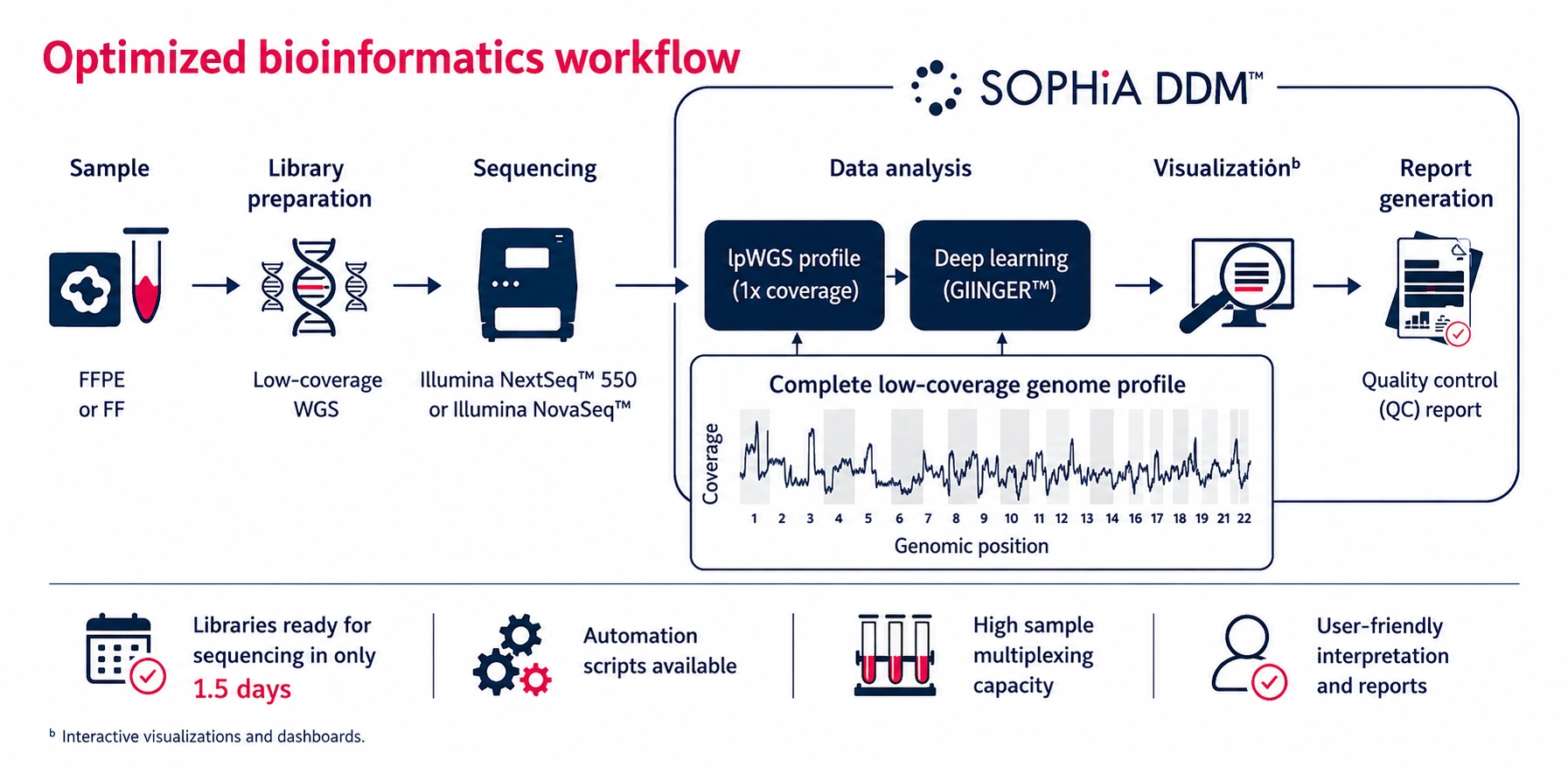
HRD analysis using GIInger and low-pass whole-genome sequencing

Clinical applications

This tool is intended for research into the mutational profile of the homologous recombination repair (HRR) pathway in FFPE or fresh-frozen tissue samples. Its applications include in-depth molecular characterisation of several types of cancer, such as ovarian, breast, prostate, colorectal, lung and pancreatic cancer.

Applications of HRS panels across different cancer types

Benefits

Scalable portfolio comprising three gene panels. Complete coverage of the coding regions and splice junctions of the included genes. Optimised probe design to maximise coverage and uniformity. Library preparation in approximately 1.5 days. Integrated sample-to-report solution. Compatibility with multiple Illumina® platforms. Automation available to support implementation. Advanced interpretation and report-generation tools. Access to the SOPHiA GENETICS community for support with variant interpretation.

Technology

SOPHiA DDM™ HRS solutions use targeted hybrid capture technology and next-generation sequencing (NGS) to analyse genes involved in the homologous recombination repair (HRR) pathway. The assays incorporate SOPHiA GENETICS™ Universal Library Prep for library preparation and specific capture probes to enrich the coding regions and splice sites of the genes included in each panel. Bioinformatic analysis is performed using the SOPHiA DDM™ platform, enabling the detection of SNVs, indels and gene amplifications, as well as automated interpretation of the identified alterations.

Intended users

Molecular genetics laboratories. Molecular oncology laboratories. Oncology research centres. Institutions conducting HRR/HRD biomarker studies using NGS.

Additional considerations

For Research Use Only (RUO). Not intended for diagnostic procedures. Performance may vary depending on the sequencing platform used. Analysis time depends on the number of samples processed and the system workload.

Key features

Portfolio comprising three panels: mini HRS, HRS and ExtHRS. Analysis of genes involved in homologous recombination repair (HRR). Complete coverage of coding regions and relevant splice regions. Detection of SNVs, indels and gene amplifications. Integrated workflow from library preparation to final report. SOPHiA DDM™ platform for analysis and interpretation. Compatible with multiple Illumina® platforms. Library preparation in approximately 1.5 days. Access to advanced interpretation and report-generation tools.

Product details

Product type: Bundle solution (wet-lab reagents + analytical credits for the cloud-based SOPHiA DDM™ platform).
Sample type: FFPE.
Feature SOPHiA DDM™ mini HRS SOPHiA DDM™ HRS SOPHiA DDM™ ExHRS
Samples
Up to 24 samples for Illumina MiniSeq™ kit Up to 32 samples for Illumina MiSeq® kit v3 Up to 24 samples for Illumina MiSeq® kit v2
Up to 8 samples for Illumina MiSeq® kit v3 Up to 4 samples for Illumina MiSeq® kit v2 Up to 16 samples for Ion Torrent™ Ion S5™ System
Up to 32 samples for Illumina® NextSeq® 500/550 Mid Output Kita
Product codes BS0111ILLRSMY05-16;
BS0111ILLRSMY05-32;
BS0111ILLRSMY05-48
MiSeq®:
BS0108ILLRSMY05-16;
BS0108ILLRSMY05-32;
BS0108ILLRSMY05-48

IonTorrent™:
BS0108TFSRSML03-016;
BS0108TFSRSML03-032
BS0128ILLRSMY10-16;
BS0128ILLRSMY10-32;
BS0128ILLRSMY10-48;
BS0128ILLRSMY10-96

SOPHiA DDM™ mini HRS
Samples
Up to 24 samples for Illumina MiniSeq™ kit Up to 32 samples for Illumina MiSeq® kit v3 Up to 24 samples for Illumina MiSeq® kit v2
Product codes BS0111ILLRSMY05-16;
BS0111ILLRSMY05-32;
BS0111ILLRSMY05-48
SOPHiA DDM™ HRS
Samples
Up to 8 samples for Illumina MiSeq® kit v3 Up to 4 samples for Illumina MiSeq® kit v2 Up to 16 samples for Ion Torrent™ Ion S5™ System
Product codes MiSeq®:
BS0108ILLRSMY05-16;
BS0108ILLRSMY05-32;
BS0108ILLRSMY05-48

IonTorrent™:
BS0108TFSRSML03-016;
BS0108TFSRSML03-032
SOPHiA DDM™ ExHRS
Samples Up to 32 samples for Illumina® NextSeq® 500/550 Mid Output Kita
Product codes BS0128ILLRSMY10-16;
BS0128ILLRSMY10-32;
BS0128ILLRSMY10-48;
BS0128ILLRSMY10-96
What does the solution include?

SOPHiA GENETICS Universal Library Prep reagents for library preparation from fragmented DNA. Hybridisation probes for targeted capture. Full access and credits for secondary and tertiary analysis on the SOPHiA DDM™ platform.

Required reagents and materials not included in the kit

Genomic DNA extraction kits for FFPE samples. Equipment and reagents for fluorometric quantification and nucleic acid quality control, such as Qubit™, TapeStation™ or equivalent. Sequencing reagents specific to Illumina platforms and Illumina PhiX v3 control.

Area:

Digestive System, Endocrine System, HRD, Reproductive System, Respiratory System, Solid tumor
Consult our experts

Google reCaptcha: Invalid site key.

Related products

MSK-ACCESS® powered with SOPHiA DDM™

In-house liquid biopsy solution based on hybrid-capture next-generation sequencing (NGS) technology for the ultrasensitive detection of somatic alterations in circulating cell-free DNA from plasma. Developed in collaboration with Memorial Sloan Kettering Cancer Center (MSK), it implements a robust matched tumor-normal sequencing approach (plasma cfDNA + white blood cell DNA) to filter germline variants and mutations…
SOPHIA Genetics
Next Generation Sequencing (NGS)

MSK-IMPACT® / MSK-IMPACT® FLEX

Decentralised, in-house comprehensive genomic profiling (CGP) solution for solid tumours, based on hybrid capture next-generation sequencing (NGS). Developed in collaboration with Memorial Sloan Kettering Cancer Center (MSK), it features a robust matched tumour-normal sequencing approach for filtering germline variants and clonal haematopoiesis. Detailed description Operating principle The decentralised MSK-IMPACT® powered with SOPHiA DDM™ solution enables…
SOPHIA Genetics
Next Generation Sequencing (NGS)

Homologous Recombination Deficiency (HRD) Solution

Homologous Recombination Deficiency (HRD) Solution NGS- and low-pass whole-genome sequencing (low-pass WGS)-based solution for determining homologous recombination deficiency (HRD) status in ovarian cancer. Operating Principle This comprehensive solution, available as CE-IVD and for Research Use Only (RUO), is designed to support the determination of tumour HRD status in patients with ovarian cancer. It integrates two…
SOPHIA Genetics
Next Generation Sequencing (NGS)

Community Solutions for Solid Tumors

A portfolio of pre-designed and optimised NGS solutions based on hybrid-capture technology for comprehensive analysis of biomarkers associated with solid tumours from DNA and RNA. Designed by genomic experts to simplify in-house implementation and accelerate cancer research, these applications integrate natively with the analytical and interpretative capabilities of the cloud-based SOPHiA DDM™ platform. They provide…
SOPHIA Genetics
Next Generation Sequencing (NGS)