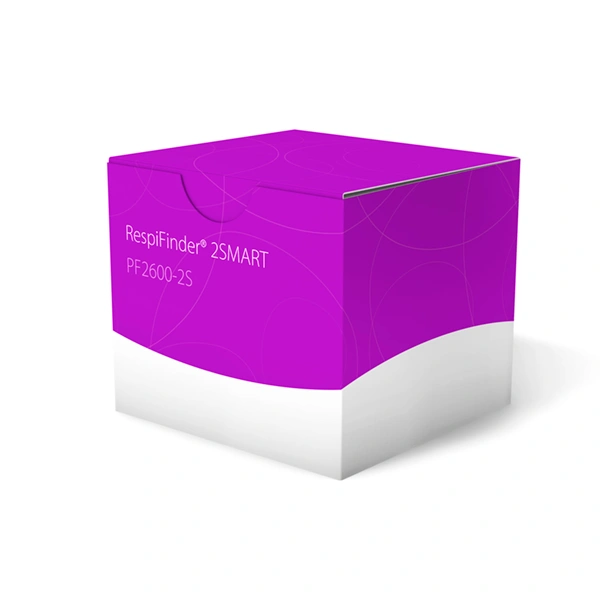
Multiplex qualitative real‑time PCR kit for the diagnosis of respiratory tract infections, allowing the simultaneous detection and differentiation of 22 respiratory pathogens (18 RNA viruses, 2 DNA viruses and 4 bacteria) in a single reaction.

Product Description

The RespiFinder® 2SMART kit is a qualitative in vitro diagnostic test designed to aid in the rapid and accurate diagnosis of acute respiratory tract infections (both upper and lower). By allowing the co‑amplification and differentiation of multiple pathogens in a single sample, it facilitates the identification of mixed infections, optimises clinical decisions, and improves patient prognosis.

Detected Pathogens

RNA viruses: Influenza A, Influenza B, Influenza A H1N1pdm09, Respiratory Syncytial Virus A (RSV-A), Respiratory Syncytial Virus B (RSV-B), SARS-CoV-2, Parainfluenza 1, Parainfluenza 2, Parainfluenza 3, Parainfluenza 4, Coronavirus OC43, Coronavirus 229E, Coronavirus HKU1/NL63, Coronavirus MERS, Rhinovirus/Enterovirus, Human Metapneumovirus (hMPV) and Bocavirus type 1. DNA viruses: Adenovirus. Bacteria: Mycoplasma pneumoniae, Chlamydophila pneumoniae, Legionella pneumophila and Bordetella pertussis.

Key Advantages and Features

Comprehensive surveillance: Simultaneous detection of 22 key pathogens responsible for acute respiratory infections in adults and children. Treatment optimisation: Clear identification of co‑infections and monitoring of critical agents such as SARS-CoV‑2 and Influenza for appropriate treatment. Safety and control: Includes an MS2 bacteriophage internal control (IC) to monitor extraction and PCR inhibition, plus amplification controls (AC) and positive controls (PC). Validated samples: Optimised for nasopharyngeal swabs with nucleic acid extraction protocols validated on QIAamp® MinElute, QIsymphony® and Nuclisens® easyMAG® systems. Simple and Adaptable: Seamless integration into hospital laboratory workflows without the need for additional complex equipment.
×

Area:

Bacteria, Microbiology, Virus
Consult our experts

Google reCaptcha: Invalid site key.

Related products

SOPHiA DDM GEN2

Analytical platform for clinical genomics that enables the detection, annotation, and interpretation of genomic variants using artificial intelligence to support patient diagnosis and treatment. Detailed Description SOPHiA DDM™ Platform is an advanced solution for precision medicine workflows, with a renewed interface, web access, and new functionalities to accelerate genomic data analysis. It offers end‑to‑end workflows…
SOPHIA Genetics

PGT-SR (Preimplantation Genetic Testing for Chromosomal Structural Rearrangements)

PGT‑SR (Preimplantation Genetic Testing for Structural Chromosomal Rearrangements) is a solution aimed at the analysis of structural chromosomal rearrangements in embryos. According to the product literature, it is based on single‑cell whole‑genome amplification and NGS sequencing to detect embryos from patients with chromosomal abnormalities and select euploid embryos for transfer, with the aim of reducing…
Yikon Genomics
Next Generation Sequencing (NGS)

MaReCs (Mapping allele with resolved carrier state test)

MaReCs® (Allelic Mapping with Resolved Carrier Status) is a PGT‑SR technology that first identifies aneuploid or euploid embryos and then analyses translocation breakpoints and SNP linkage to differentiate carrier from non‑carrier euploid embryos. Detailed Description Principle of operation MaReCs® combines ChromSwift® technology with NGS sequencing to perform a CNV analysis and subsequently an SNP linkage…
Yikon Genomics
Next Generation Sequencing (NGS)

KaryoSeq (Integrated solution for PGT-M, PGT-SR and PGT-A)

KaryoSeq™ is a next‑generation sequencing (NGS)‑based solution for preimplantation genetic testing that enables PGT‑M, PGT‑SR and PGT‑A within a single workflow. It is designed for the analysis of DNA extracted from 3 to 10 trophectoderm cells of human embryos at the blastocyst stage. Detailed Description Principle of operation KaryoSeq™ is based on the MARSALA principle…
Yikon Genomics
Next Generation Sequencing (NGS)