Twist custom panels are highly customisable solutions, allowing the exact selection of regions, genes, pathways or variants of interest. They are designed to offer high performance, flexibility and precision in all types of applications and starting samples.
Detailed Description
Operating principle:
In practice, the use of custom panels makes it possible to overcome the limitations of standard panels, giving the laboratory complete control over which regions to sequence and allowing the design of panels adapted to specific biological questions, avoiding generic approaches and enabling the analysis to focus on specific genes, pathways, variants or regions.
To achieve this, Twist technology combines proprietary chemistry for the design of double-stranded DNA (dsDNA) probes with its capture enrichment solution, ensuring high quality and optimal panel performance in DNA and RNA applications and even methylation studies.
The design and quality controls of the probes (performed by NGS) are optimised to ensure an exceptional coverage uniformity rate, high reproducibility and a high on-target ratio regardless of panel size. With all this, Twist chemistry maximises sequencing efficiency, making the most of each laboratory’s resources.
In addition, the modularity of Twist reagents makes it possible to adapt the use of these custom panels to any type of application in both germline and somatic contexts. From good-quality DNA and RNA samples obtained from sources such as whole blood to complex samples such as cfDNA or those obtained from paraffin-embedded tissue.
Benefits
Exceptional performance: high coverage uniformity, on-target ratio and reproducibility, allowing you to get the most out of your assays.
Optimisation of sequencing costs for more efficient use of resources
Simple and agile customisation with support throughout the entire process.
Versatility of applications and sample types: germline/somatic, DNA/RNA/cfDNA, blood/FF/FFPE.
Automation available on different systems (Hamilton, Revvity, etc)
Technology used:
The Twist design platform incorporates different approaches depending on the type of application:
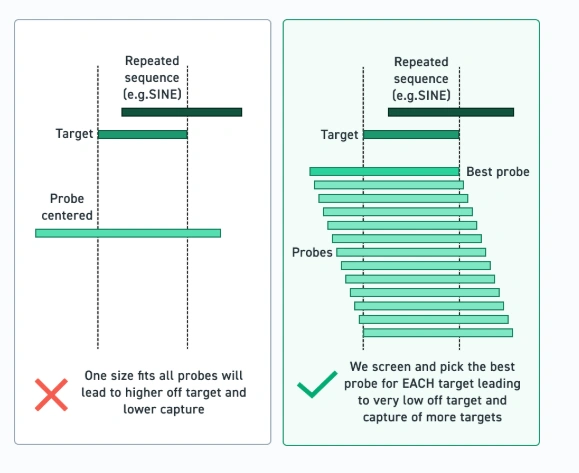
DNA: custom targeted enrichment panels for obtaining specific genomic data. It includes strategies such as probe shifter technology to improve design performance and precision, or different tiling strategies to optimise the capture of complex regions or alterations.
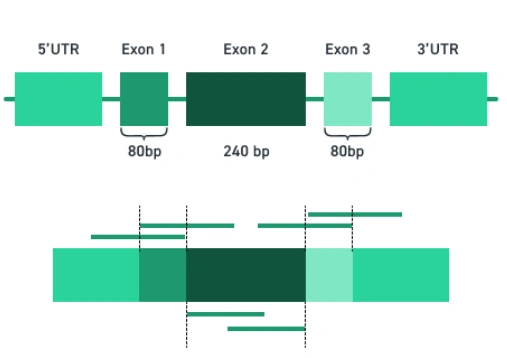
RNA: custom panels for capturing transcriptomic data from libraries converted to cDNA. The design uses strategies such as exon-aware placement to promote the capture of isoforms, fusions and complex exons.
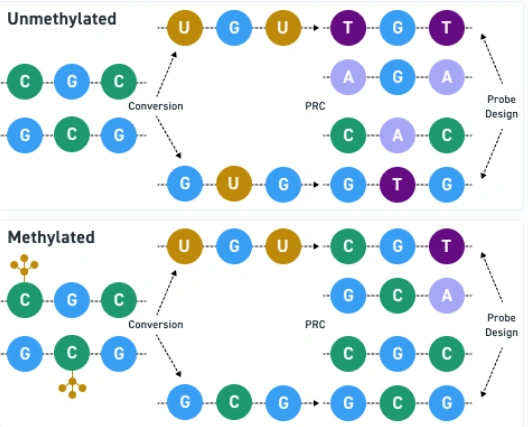
Methylation: custom methylated DNA panels with a design that includes four probe species per target: fully methylated, fully unmethylated, sense and antisense, with the aim of preserving methylation pattern information and maintaining high uniformity.
Intended audience/user:
Solution intended for laboratories and research teams that need to design custom NGS panels to answer specific questions in DNA, RNA or methylation studies. It is especially intended for users who require flexibility in target selection, high capture performance and efficient use of sequencing.
Intended use for microbiology:
Viruses: Whole-genome sequencing of pathogens from primary samples. Epidemiological surveillance. Antiviral resistance. Targeted metagenomics
Bacteria: genomic surveillance. Whole-genome sequencing of pathogens from primary samples. Antimicrobial resistance. Targeted metagenomics, typing and molecular epidemiology
Key Aspects
✓
Complete control over the targets to be studied and agile panel customisation according to specific genes, pathways or variants.
✓
High-performance enrichment for DNA, RNA and methylation.
✓
Uniform coverage and a high on-target proportion, even in GC-rich and complex regions. Uniform and reproducible data that reduce revalidation.
✓
Capture of isoforms, fusions and difficult-to-access exons. Detection of rare variants, CNVs and low-frequency events.
✓
Cost optimisation by avoiding unnecessary sequencing excess and oversized approaches.
✓
Automation
✓
Versatility in applications and sample types.
✓
Design and guidance from an expert support group.
Presentation Details
Available in a 96-reaction format