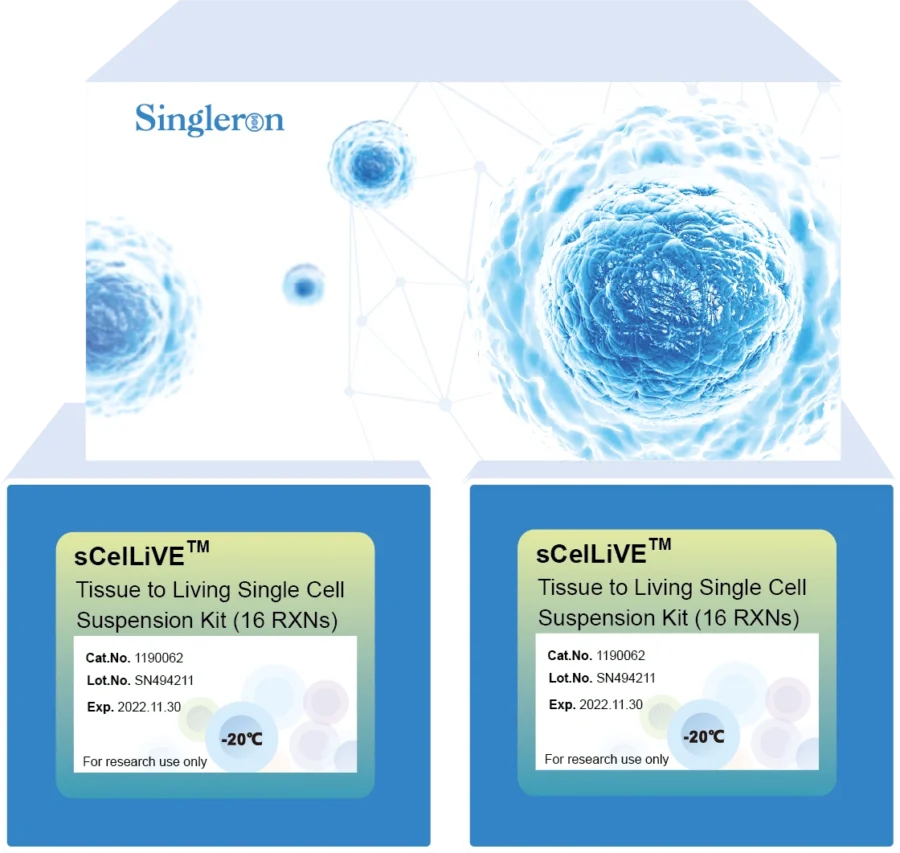
The sCelLiVE® Tissue Preservation Buffer is designed to maintain the integrity of fresh tissues without the need for chemical fixation, offering stable preservation for up to 72 hours and effectively simulating the natural physiological environment. This allows for high cell viability to be maintained even in sensitive samples. This sCelLiVE® Tissue Preservation Buffer enables gentle, prolonged preservation that is compatible with efficient dissociation.

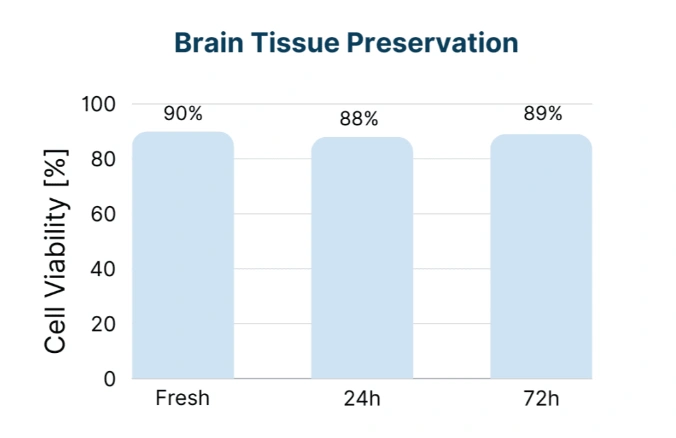
Studies performed with brain tissue, both fresh and stored at 4°C for 24 and 72 hours, show that approximately 90% of cells remain alive after 72 hours in the Preservation Buffer, demonstrating its excellent capability to protect tissues over extended periods.
sCelLiVE Tissue Preservation Buffer

Key benefits of the sCelLiVE® Buffer

Simulation of the physiological environment, maintaining optimal conditions for cell survival for up to 72 hours. 
Gentle preservation, without altering viability or causing significant changes in cellular composition.
Versatility, compatible with practically all fresh and solid tissues used in biomedical research. 
Simple workflow, with a ready-to-use solution that avoids complex preparations or protocol optimization.

Area:

Omics, Single cell

Brand:

Consult our experts

Google reCaptcha: Invalid site key.

Related products

CellScape™ Precise Spatial Proteomics

The CellScape™ Precise Spatial Proteomics platform is an optimized multiplexed immunofluorescence (mIF) solution for high-plex spatial protein detection and quantitative phenotyping. By combining an advanced imaging system with integrated microfluidics for "walk-away" automation, and an open ecosystem based on simple chemistry and robust throughput, the CellScape platform accelerates biological discovery and translational research across multiple…
Bruker
Spatial Biology

Tissue dissociation – PythoN Junior™ y PythoNi®

Singleron's dissociation instruments are designed to effortlessly integrate into your workflow, moving from tissue to a viable cell suspension quickly and easily. They automate the entire process, allowing you to work more comfortably and obtain reliable, consistent, and highly efficient results. These automated dissociation systems transform solid tissues into high-quality suspensions (viable cells) through a…
Singleron
Single cell Sequencing

Devyser LynchFAP

Devyser LynchFAP is a targeted NGS solution for the analysis of germline variants associated with hereditary colorectal cancer syndromes. The assay enables the detection of SNVs, indels, and CNVs in genes related to Lynch syndrome, familial adenomatous polyposis (FAP), and MUTYH-associated polyposis (MAP), also incorporating a specific LR-PCR for the correct localization of variants in…
Devyser
Next Generation Sequencing (NGS)

Devyser HBOC NGS

Devyser HBOC NGS is a fast and robust NGS solution aimed at the detection of germline variants in 12 genes associated with an increased risk of hereditary breast and ovarian cancer: ATM, BARD1, BRIP1, CDH1, CHEK2, NBN, PALB2, PTEN, RAD51C, RAD51D, STK11, TP53. It offers comprehensive and uniform coverage of all coding exons and exon/intron…
Devyser
Next Generation Sequencing (NGS)