Emedgene™ software is designed to optimise variant interpretation in rare diseases and other germline applications. It combines explainable artificial intelligence, automation and configurable workflows to reduce the variant curation burden and accelerate tertiary analysis.
Detailed description
Key features
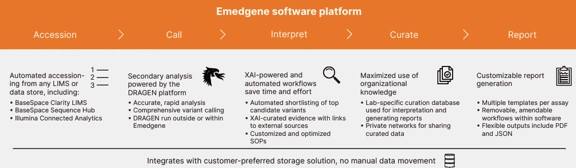
It is a comprehensive solution developed to streamline genetic interpretation workflows and reduce the manual effort associated with variant curation. It is aimed at laboratories working with large volumes of data from next‑generation sequencing (NGS).
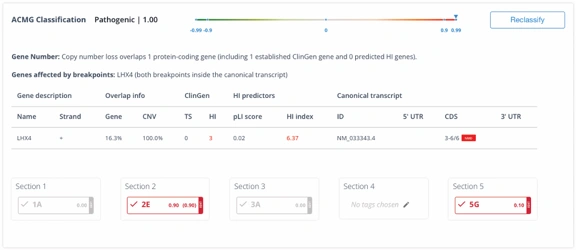
It allows the identification of different types of variants, including single nucleotide variants (SNV), insertions/deletions (indels), copy number variants (CNV), mitochondrial DNA variants (mtDNA), structural variants (SV) and short tandem repeats (STR).
Principle of operation
The platform uses proprietary machine learning algorithms and explainable artificial intelligence to prioritise candidate variants and automatically associate them with relevant evidence. The system generates a prioritised list of variants for review and links each finding with information from scientific literature and external databases.
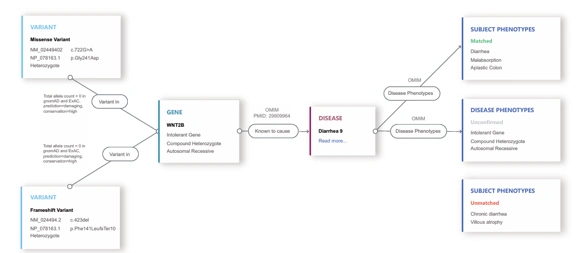
The software incorporates an evidence graph that replicates the usual work of an interpretation specialist, showing relationships between disease, gene, inheritance pattern, subject phenotype and variant. Each piece of evidence is linked to external sources, such as scientific literature or databases, facilitating a fast, traceable and well‑founded review.
Applications
Emedgene™ software is aimed at research applications in rare diseases and other genetic diseases, pharmacogenomics, cytogenetics, germline conditions and carrier screening studies.
The platform can be used in whole‑genome, whole‑exome, targeted panel and microarray‑based studies, providing a flexible solution for laboratories that need to interpret complex genetic data in different research contexts.
Benefits
Intended user / audience
Software solution aimed at genetics laboratories that need to optimise and scale variant interpretation in germline studies, rare diseases, cytogenetics, pharmacogenomics, carrier screening and other genetic research applications.