Emedgene

Emedgene™ software is designed to optimise variant interpretation in rare diseases and other germline applications. It combines explainable artificial intelligence, automation and configurable workflows to reduce the variant curation burden and accelerate tertiary analysis.

Detailed description

Key features

It is a comprehensive solution developed to streamline genetic interpretation workflows and reduce the manual effort associated with variant curation. It is aimed at laboratories working with large volumes of data from next‑generation sequencing (NGS).

It allows the identification of different types of variants, including single nucleotide variants (SNV), insertions/deletions (indels), copy number variants (CNV), mitochondrial DNA variants (mtDNA), structural variants (SV) and short tandem repeats (STR).
Emedgene key features

Principle of operation

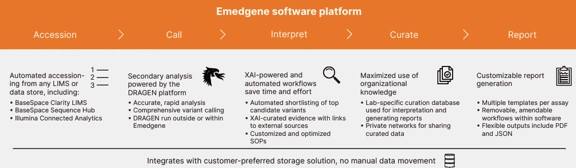
The platform uses proprietary machine learning algorithms and explainable artificial intelligence to prioritise candidate variants and automatically associate them with relevant evidence. The system generates a prioritised list of variants for review and links each finding with information from scientific literature and external databases.

The software incorporates an evidence graph that replicates the usual work of an interpretation specialist, showing relationships between disease, gene, inheritance pattern, subject phenotype and variant. Each piece of evidence is linked to external sources, such as scientific literature or databases, facilitating a fast, traceable and well‑founded review.
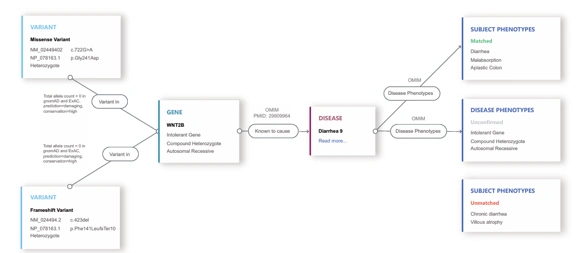
Emedgene principle of operation

Applications

Emedgene™ software is aimed at research applications in rare diseases and other genetic diseases, pharmacogenomics, cytogenetics, germline conditions and carrier screening studies.

The platform can be used in whole‑genome, whole‑exome, targeted panel and microarray‑based studies, providing a flexible solution for laboratories that need to interpret complex genetic data in different research contexts.

Benefits
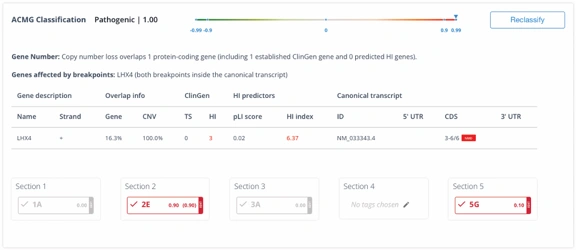
Improves tertiary analysis efficiency through automation and explainable artificial intelligence. This automation helps reduce repetitive tasks associated with evidence search and connection, variant prioritisation, curation, classification and report generation. Allows configuration of standardised operating procedures through custom filters, workflows, report templates and validation and production environments.
Emedgene benefits
Facilitates the reuse of internal laboratory knowledge through a proprietary database of curated variants and genes. This information can be automatically used to annotate cases and complete interpretation templates, improving efficiency as the curated data history grows. Integration with DRAGEN™ secondary analysis, providing accurate, complete and efficient variant calls as input for downstream interpretation. Allows the creation of custom reports, editing them within the software using a Microsoft Word‑like tool, sending them for additional review and downloading them in PDF or JSON format.

Intended user / audience

Software solution aimed at genetics laboratories that need to optimise and scale variant interpretation in germline studies, rare diseases, cytogenetics, pharmacogenomics, carrier screening and other genetic research applications.

Key features

Software for tertiary analysis and variant interpretation in germline applications, rare diseases and other genetic studies. Explainable artificial intelligence for variant prioritisation, with evidence automatically linked to scientific literature and external databases. 50–75% reduction in total workflow time per subject and 2–5‑fold efficiency increase compared to manual interpretation. Causal variant prioritised in the top 10 in 96.6% of samples evaluated in a validation study with WES data. Compatibility with WGS, WES, targeted panels and microarrays. Integration with DRAGEN™ secondary analysis, BaseSpace™ Sequence Hub and Illumina Connected Analytics. Automated ACMG classification for SNVs, indels, CNVs, SVs and mtDNA variants. Customisable report generation with PDF and JSON outputs. Security aligned with HIPAA, GDPR, ISO 27001 and SOC 1/2 Type II.
×

Area:

Molecular Genetics, Software, Software solutions for germline analysis

Technology:

Brand:

Consult our experts

Google reCaptcha: Invalid site key.

Related products

SOPHiA DDM GEN2

Analytical platform for clinical genomics that enables the detection, annotation, and interpretation of genomic variants using artificial intelligence to support patient diagnosis and treatment. Detailed Description SOPHiA DDM™ Platform is an advanced solution for precision medicine workflows, with a renewed interface, web access, and new functionalities to accelerate genomic data analysis. It offers end‑to‑end workflows…
SOPHIA Genetics

PGT-SR (Preimplantation Genetic Testing for Chromosomal Structural Rearrangements)

PGT‑SR (Preimplantation Genetic Testing for Structural Chromosomal Rearrangements) is a solution aimed at the analysis of structural chromosomal rearrangements in embryos. According to the product literature, it is based on single‑cell whole‑genome amplification and NGS sequencing to detect embryos from patients with chromosomal abnormalities and select euploid embryos for transfer, with the aim of reducing…
Yikon Genomics
Next Generation Sequencing (NGS)

MaReCs (Mapping allele with resolved carrier state test)

MaReCs® (Allelic Mapping with Resolved Carrier Status) is a PGT‑SR technology that first identifies aneuploid or euploid embryos and then analyses translocation breakpoints and SNP linkage to differentiate carrier from non‑carrier euploid embryos. Detailed Description Principle of operation MaReCs® combines ChromSwift® technology with NGS sequencing to perform a CNV analysis and subsequently an SNP linkage…
Yikon Genomics
Next Generation Sequencing (NGS)

KaryoSeq (Integrated solution for PGT-M, PGT-SR and PGT-A)

KaryoSeq™ is a next‑generation sequencing (NGS)‑based solution for preimplantation genetic testing that enables PGT‑M, PGT‑SR and PGT‑A within a single workflow. It is designed for the analysis of DNA extracted from 3 to 10 trophectoderm cells of human embryos at the blastocyst stage. Detailed Description Principle of operation KaryoSeq™ is based on the MARSALA principle…
Yikon Genomics
Next Generation Sequencing (NGS)