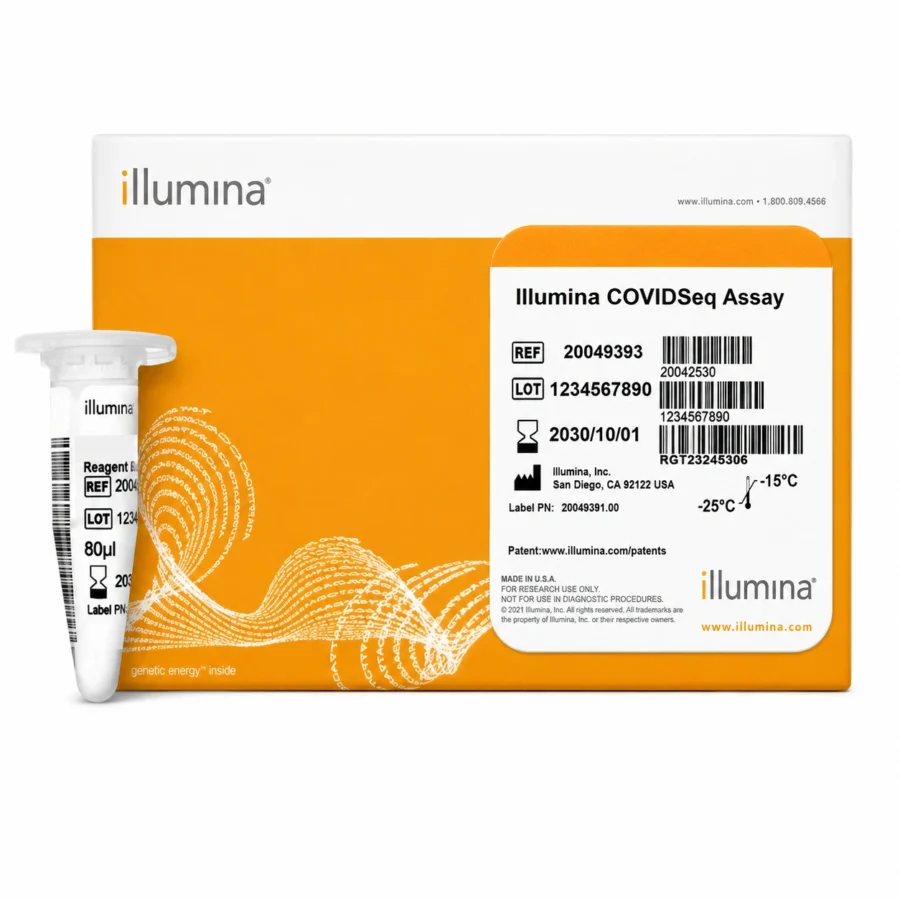
Next-generation sequencing (NGS) amplicon-based assay for the detection and characterization of SARS-CoV-2. It integrates library preparation, sequencing, and data analysis into a workflow aimed at genomic surveillance and is for research use only.
3.- Detailed Description
Principle of operation
Illumina COVIDSeq is integrated into a complete workflow for the detection and characterization of SARS-CoV-2, from RNA isolation to library preparation, sequencing, and bioinformatic analysis. The process comprises annealing of extracted RNA using random hexamers, first-strand cDNA synthesis, amplification of the material in two PCR reactions, amplicon tagmentation, subsequent clean‑up, incorporation of i7 and i5 indexes, pool formation, and final library clean‑up, with the aim of generating sequencing‑ready libraries from SARS‑CoV‑2 samples.
Clinical applications
The documentation places this assay in the field of SARS‑CoV‑2 RNA sequencing and monitoring of viral genome characteristics, allowing the identification, tracking, and monitoring of the emergence and prevalence of new variants, strains, and lineages from samples originating from nasopharyngeal, oropharyngeal, and nasal swabs. Its application is oriented to research and clinical research environments linked to genomic surveillance.
Benefits
Among its main advantages is its integrated and optimized workflow, designed to adapt flexibly to different laboratory settings, especially in research and clinical research, by combining library preparation, sequencing, and data analysis into a single process. Added to this is its suitability for decentralized SARS‑CoV‑2 surveillance strategies and its ability to offer uniform coverage of the viral genome, with special relevance in the spike protein region, key for variant characterization. As a result, the assay allows SARS‑CoV‑2 detection, alignment against the reference genome, variant calling, generation of consensus sequences, and assignment of viral lineages and subtypes.
Key results or indicators
Illumina COVIDSeq provides uniform coverage of the SARS‑CoV‑2 genome, with particular robustness in the S protein region, key for variant identification and characterization. Illumina’s documentation shows that ARTIC v5.4.2 primers improve coverage of new Omicron variants, especially in the spike region, favoring a more complete and accurate characterization of emerging variants. Illumina indicates that paired‑end sequencing strategies improve performance over single‑read and that, in the samples evaluated, genomic coverages ≥ 99% can be achieved with 2 × 76 bp configurations or higher and depths of at least 1 million reads per sample, reinforcing the reliability of the assay for genomic surveillance programs and monitoring of viral lineages.
Technology used
This is a next‑generation sequencing (NGS) amplicon‑based assay that includes the reagents necessary for RNA‑to‑cDNA conversion, amplification, and library preparation, and incorporates ARTIC v5.4.2 primers for the detection and characterization of SARS‑CoV‑2. Regarding bioinformatic analysis, the COVIDSeq workflow relies on Illumina’s DRAGEN tools in BaseSpace Sequence Hub, which allow aligning reads against a reference genome, performing variant calling, generating a consensus sequence, and obtaining lineage and subtype information for genomic surveillance applications.
Intended user / audience
This assay is aimed at laboratories that need a SARS‑CoV‑2 sequencing solution working in clinical research, genomic characterization, and variant surveillance, especially in environments that use Illumina sequencing platforms and require a structured workflow from library preparation to bioinformatic analysis.
Considerations or limitations
The product is for research use only and must not be used in diagnostic procedures. Pre‑analytical sample quality, including collection, transport, and storage conditions, as well as the stage of infection and possible RNA degradation, can compromise SARS‑CoV‑2 detection, so the protocol requires rigorous contamination control and proper handling of material to preserve its integrity.
4.- Key Features
5.- Presentation Details
Format
Sequencing assay with capacity for 96 and 3072 samples.
Kit Contents
References
| Illumina COVIDSeq Assay (96 Samples) | — |
| Illumina COVIDSeq Assay Box 1 – 96 Samples | Part # 20051272 |
| Illumina COVIDSeq Assay Box 2 – 96 Samples | Part # 20051273 |
| Illumina COVIDSeq Assay Box 3 – 96 Samples | Part # 20051274 |
| Illumina COVIDSeq Assay Box 4 – 96 Samples, Indexes | — |
| Illumina COVIDSeq Positive Control HT | Part # 20051775 |
| Illumina COVIDSeq Test (RUO) Kit Contents (3072 Samples) | — |
| Illumina COVIDSeq Test Box 1 – 3072 Samples | Part # 20044405 |
| Illumina COVIDSeq Test Box 2 – 3072 Samples | Part # 20044406 |
| Illumina COVIDSeq Test Box 3 – 3072 Samples | Part # 20044407 |
| Illumina COVIDSeq Positive Control HT | Part # 20043401 |
| IDT for Illumina-PCR Indexes | — |
| IDT for Illumina-PCR Indexes Set 1 (96 Indexes) | Part # 20043132 |
| IDT for Illumina-PCR Indexes Set 2 (96 Indexes) | Part # 20043132 |
| IDT for Illumina-PCR Indexes Set 3 (96 Indexes) | Part # 20043132 |
| IDT for Illumina-PCR Indexes Set 4 (96 Indexes) | Part # 20043132 |